PLL Core Feedback Clock Latency
When using a PLL as a clock source you need to account for the any board delay, the GPIO input buffer delay (for the PLL's reference clock pin), and the PLL compensation delay.
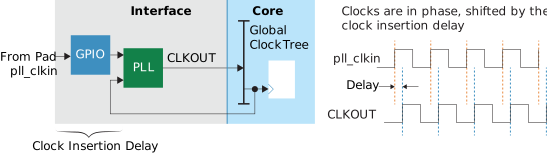
When the PLL is in core feedback mode, the compensation delay is equal to the clock network delay.
The SDC constraint formulas for the receive clock delay are:
set_clock_latency -source -setup <max calculation> <clock ports>
set_clock_latency -source -hold <min calculation> <clock ports>
The equations are:
<max calculation> = <max board constraint> + GPIO_INmax - <PLL compensation>
<min calculation> = <min board constraint> + GPIO_INmin - <PLL compensation>
The Efinity software v2023.2 and higher calculates the GPIO input buffer and PLL compensation delays and provides them in a template in the <project>.pt.sdc file. You still need to add any board delays if needed.
Setting PLL Core Feedback Clock Latency
clk. This
example assumes that the clock and data traces on the board are well matched;
therefore, there is no external board delay. ---------- 1. PLL Timing Report (begin) ----------
+--------+----------+-----------+-...-+------------------+------------------+
| PLL | Resource | Reference | ... | PLL Compensation | PLL Compensation |
|Instance| | Clock | ... | Delay Max (ns) | Delay Min (ns) |
+--------+----------+-----------+-...-+------------------+------------------+
| pll | PLL_TR0 | external | ... | 4.310 | 2.155 |
+--------+----------+-----------+-...-+------------------+------------------+
+-------+-------------+-----------------------+
| Clock | Period (ns) | Phase Shift (degrees) |
+-------+-------------+-----------------------+
| clk | 10.0000 | 0 |
+-------+-------------+-----------------------+
Non-registered GPIO Configuration:
===================================
+---------------+----------+-----------+----------+----------+
| Instance Name | Pin Name | Parameter | Max (ns) | Min (ns) |
+---------------+----------+-----------+----------+----------+
| i | i | GPIO_IN | 1.396 | 0.698 |
| refclk | refclk | GPIO_IN | 1.476 | 0.738 |
| o | o | GPIO_OUT | 3.829 | 1.915 |
+---------------+----------+-----------+----------+----------+# Clock Latency Constraints
############################
# set_clock_latency -source -setup <board_max -2.834> [get_ports {clk}]
# set_clock_latency -source -hold <board_min -1.457> [get_ports {clk}]set_clock_latency -source -setup -2.834 [get_ports clk]
set_clock_latency -source -hold -1.457 [get_ports clk]