Output Receive Clock Delay
This example shows how to set constraints for an output receive clock.
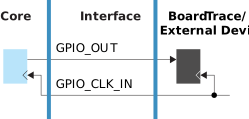
The SDC constraint formulas for the receive clock delay are:
set_output_delay -clock <clock> -max <max calculation> <ports>
set_output_delay -clock <clock> -min <min calculation> <ports>
The equations are:
<max calculation> = <max board constraint> + GPIO_OUTmax
<min calculation> = <min board constraint> + GPIO_OUTmin
The following example shows how to calculate the delays and set the constraints.
Constraining Output Receive Clock
You want to constrain the
dout output with respect to clock
clkin with a max board constraint of 4 ns and a min
board constraint of 2 ns. The non-registered GPIO configuration data from
the Interface Design report file is:Non-registered GPIO Configuration:
===================================
+---------------+----------+-------------+----------+----------+
| Instance Name | Pin Name | Parameter | Max (ns) | Min (ns) |
+---------------+----------+-------------+----------+----------+
| clkin | clkin | GPIO_CLK_IN | 1.954 | 0.526 |
| din | din | GPIO_IN | 1.954 | 0.526 |
| dout | dout | GPIO_OUT | 4.246 | 1.081 |
+---------------+----------+-------------+----------+----------+The equations are:
<max calculation> = 4 + 4.246 = 8.246
<min calculation> = 2 + 1.081 = 3.081
The resulting constraints are:
set_output_delay -clock clkin -max 8.246 dout
set_output_delay -clock clkin -min 3.081 dout
Note: The
GPIO_CLK_IN delay is accounted for in the
set_clock_latency constraint. Therefore, you do not need to
include it in the calculation for set_output_delay. Refer to Clock Latency.