Flip-Flops
The Efinity® synthesis tool recognizes flip-flops (or registers) while processing the RTL. Flip-flops can have these control signals:
- Rising or falling edge clocks
- Asynchronous set/reset
- Synchronous set/reset
- Clock enable
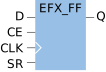
| Port | Direction | Description |
|---|---|---|
| D | Input | Input data. |
| CE | Input | Clock Enable. |
| CLK | Input | Clock. |
| SR | Input | Asynchronous/synchronous set/reset. |
| Q | Output | Output data. |
Flip-flops with active-high synchronous resets and active-high clock enables are described as sequential processes in VHDL.
library IEEE;
use IEEE.STD_LOGIC_1164.ALL;

entity D_FF_VHDL is
  port (clk, rst, ce, d  : in std_logic; q : out std_logic );
end entity D_FF_VHDL;

architecture Behavioral of D_FF_VHDL is
begin
  process (clk) is
  begin
     if rising_edge(clk) then
        if (rst='1') then
           q <= '0';
        elsif (ce='1') then
           q <= d;
        end if;
     end if;
  end process;
end architecture Behavioral;
They are described with an always statement in Verilog HDL.
module D_FF_VERILOG (d, ce, clk, reset, out);
  input d;
  input ce;
  input clk;
  input reset;
  output out;
  reg q;

  always @(posedge clk) begin
    if (reset) q <= 1’b0;
    else if (ce) q <= d;
  end
  assign out = q;
endmodule