Introduction
Titanium™ transceivers consist of a physical medium attachment (PMA) and a physical coding sublayer (PCS). The PMA connects the FPGA to the lane, generates the required clocks, and converts the data from parallel to serial or serial to parallel. The PCS contains the digital processing interface between the PMA and the FPGA fabric. The PCS supports SGMII, 10GBase-KR, and PCIe® Gen4 as well as PMA Direct. This user guide provides the specifications for the PCIe Controller interface.
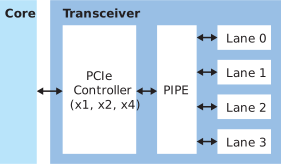
The following table shows the high-level controller configuration. It supports up to Gen4 x4, which is equivalent to a 16 Gbps lane rate or up to 64 Gbps link bandwidth.
| Parameter | Setting |
|---|---|
| Operational mode | Endpoint or root port1 |
| Link width | x1, x2, x4 |
| PIPE interface fMAX |
500 MHz, Gen 4
250 MHz, Gen 3
125 MHz, Gen 2
62.5 MHz, Gen 1
|
| PCIe Controller core clock2 | 500 MHz |
| FPGA user clock (AXI interface) fMAX3 | 125 - 250 MHz |
| FPGA user data path width (AXI interface) | 256 bits |
| AXI interface address width | 64 bits |
| Power management clock fMAX | 40 MHz |
The PCIe Controller can be configured to be either endpoint (EP) or root port (RP) mode, depending on your requirements. PCIe operations initiated by the user side are driven through the AXI4 slave port; PCIe operations initiated by the host side are driven through the AXI4 master port.
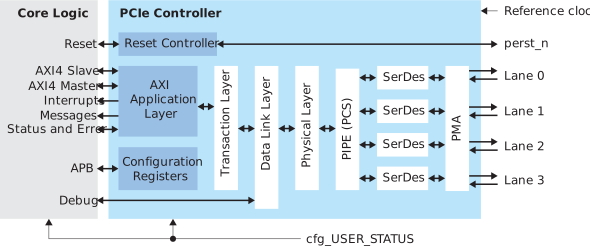
AXI_CLK, is
available to the user application