L1 Power Substates
The PCI-SIG L1 Power Management Substates ECN defines an optional mechanism to reduce idle power in the L1 link state by defining L1 substates to facilitate removing power from the PHY, and clocks to the PCIe Controller. The L1 PM substates are enabled when the link enters L1 due to PCI power management or ASPM.
- The L1.1 substate allows you to turn off clocks and most of the PHY power, but it requires the PHY to maintain common-mode voltages on the TX side.
- The L1.2 substate enables further reduction in idle power by not requiring common-mode voltages to be maintained.
The L1 PM substates use the CLKREQ# sideband signal to control the
clocks. The CLKREQ# signal is an open-drain, active-low
signal shared by the upstream and downstream ports, and either side can
assert it by driving it low. This signal enables the clock generator. The
core clock is turned off when both sides de-assert their
CLKREQ# outputs.
The PCIe Controller has the CLKREQ_IN_N input and a
CLKREQ_OUT_N output to implement the tri-state
CLKREQ# pin. The CLKREQ_OUT_N
output, when low, enables the tri-state driver driving the
CLKREQ# pin, causing assertion of the shared
signal. The port on the other side can also assert CLKREQ#
by driving it low. The PCIe Controller monitors the state of
this shared signal through the CLKREQ_IN_N input, as shown
in the following figure.
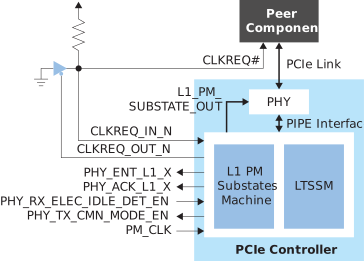
Because the core clock is turned off in the L1.1 and L1.2 substates, a separate power
management clock (PM_CLK) drives the L1 PM substates state
machine. This clock must always be active, regardless of the link's power
state. There is no requirement on the relative phase of this clock with
respect to the other PCIe Controller clocks.
The L1 PM substates state machine also provides the handshake signals
PHY_ENT_L1_X and PHY_ACK_L1_X to
prepare the local PHY for the removal of the reference clock. The state
machine asserts the PHY_ENT_L1_X output in the L1.0
substate when it has determined that the conditions for transition to the
L1.1 or L1.2 substates are met. It then waits for the PHY to assert
PHY_ACK_L1_X before de-asserting
CLKREQ_OUT_N and entering L1.1 or L1.2 substates.
During L1.1 or L1.2 exit, the PCIe Controller de-asserts
PHY_ENT_L1_X to the PHY and waits for the
corresponding de-assertion of PHY_ACK_L1_X before
transitioning to the L1.0 state. This step is required to ensure that the
PHY is fully operational and the clocks are stable before entering L1.0. For
the case of L1.2, the PHY handshake is performed while in the L1.2 exit
substate.
PHY_ENT_L1_X changes the PHY state from the L1 substate
to L1.0. Make sure that the PHY has a stable reference clock during the exit
process.The L1 PM substates state machine provides an output signal
PHY_RX_ELEC_IDLE_DET_EN to inform the PHY when to
enable its electrical idle detection circuits on the RX side. The PCIe Controller asserts this output in all states except
when the L1 PM substates state machine is in the L1.1, L1.2.Entry, and
L1.2.Idle substates.
The L1 PM substates state machine also provides an output signal
PHY_TX_CMN_MODE_EN to enable common mode on the PHY
TX. The PCIe Controller de-asserts this output when the L1 PM
substates state machine is in the L2.Idle substate, and asserts it at all
other times.