About the HVIO Interface
The HVIOs are grouped into banks. Each bank has its own VCCIO33 that sets the bank voltage for the I/O standard. Each HVIO consists of I/O logic and an I/O buffer. I/O logic connects the core logic to the I/O buffers. I/O buffers are located at the periphery of the device.
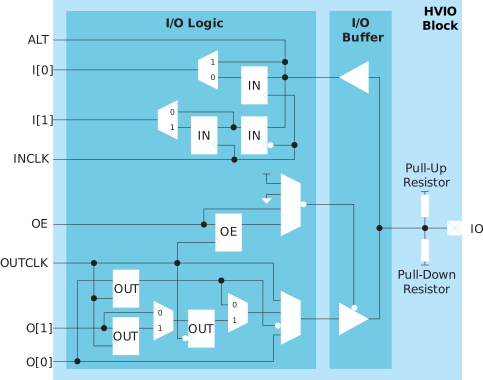
| Signal | Direction | Description |
|---|---|---|
| I[1:0] | Output | Input data from the HVIO pad to the core fabric. I[0] is the
normal input to the core. In DDIO mode, I[0] is the data captured on
the positive clock edge (HI pin name in the Interface Designer) and
I[1] is the data captured on the negative clock edge (LO pin name in
the Interface Designer). |
| ALT | Output | Alternative input connection (in the Interface Designer, Register Option is none). HVIO only support pll_clkin as the alternative connection. |
| O[1:0] | Input | Output data to HVIO pad from the core fabric. O[0] is the normal
output from the core. In DDIO mode, O[0] is the data captured on the
positive clock edge (HI pin name in the Interface Designer) and O[1]
is the data captured on the negative clock edge (LO pin name in the
Interface Designer). |
| OE | Input | Output enable from core fabric to the I/O block. Can be registered. |
| OUTCLK | Input | Core clock that controls the output and OE registers. This clock is not visible in the user netlist. |
| INCLK | Input | Core clock that controls the input registers. This clock is not visible in the user netlist. |
| Signal | Direction | Description |
|---|---|---|
| IO | Bidirectional | HVIO pad. |