HSIO Configured as MIPI Lane
You can configure the HSIO block as a MIPI RX or TX lane. The block supports bidirectional data lane, unidirectional data lane, and unidirectional clock lane which can run at speeds up to 1.3 Gbps. The MIPI lane operates in high-speed (HS) and low-power (LP) modes. In HS mode, the HSIO block transmits or receives data with x8 serializer/deserializer. In LP mode, it transmits or receives data without deserializer/serializer.
- Multiple MIPI RX or TX lanes (at least a clock lane and a data lane)
- Soft MIPI D-PHY IP core programmed into the FPGA fabric
The MIPI D-PHY standard is a point-to-point protocol with one endpoint (TX) responsible for initiating and controlling communication. Often, the standard is unidirectional, but when implementing the MIPI DSI protocol, you can use one TX data lane for LP bidirectional communication.
The protocol is source synchronous with one clock lane and 1, 2, 4, or 8 data lanes. The number of lanes available depends on which package you are using. A dedicated HSIO block is assigned on the RX interface as a clock lane while the clock lane for TX interface can use any of the HSIO block in the group.
MIPI RX Lane
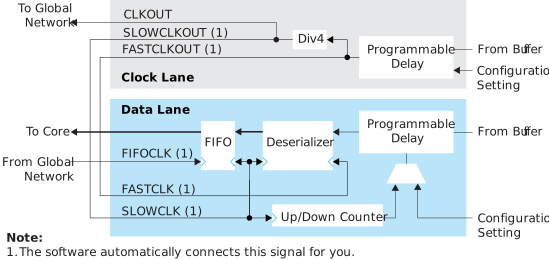
In RX mode, the HS (fast) clock comes in on the MIPI clock lane and is divided down to generate the slow clock. The fast and slow clocks are then passed to neighboring HSIO blocks to be used for the MIPI data lanes.
The data lane fast and slow clocks must be driven by a clock lane in the same MIPI group (dedicated buses drive from the clock lane to the neighboring data lanes).
The MIPI RX function is defined as:
| MIPI RX Function | Description |
|---|---|
| RX_DATA_xy_zz | MIPI RX Data Lane. You can use any data lanes within the same
group to form multiple lanes of MIPI RX channel. x = P or
N y = 0 to 7 data lanes (Up to 8 data lanes per
channel)
Tz50
zz = I0 to I11 MIPI RX channel (up to 12 MIPI RX
channels)
Tz110, Tz170
zz = I0 to I17 MIPI RX channel (up to 18 MIPI RX
channels)
zz =
I5,
I6, I7, I13, I14, I15 MIPI RX channel
(up
to 12 MIPI RX channels)
|
| RX_CLK_x_zz | MIPI RX Clock Lane. One clock lane is required for each MIPI
RX channel. x = P or N
Tz50
zz = I0 to I11 MIPI RX channel (Up to 12 MIPI RX
channels)
Tz110, Tz170
zz = I0 to I17 MIPI RX channel (Up to 18 MIPI RX
channels)
zz =
I5,
I6, I7, I13, I14, I15 MIPI RX channel
(up
to 12 MIPI RX channels)
|
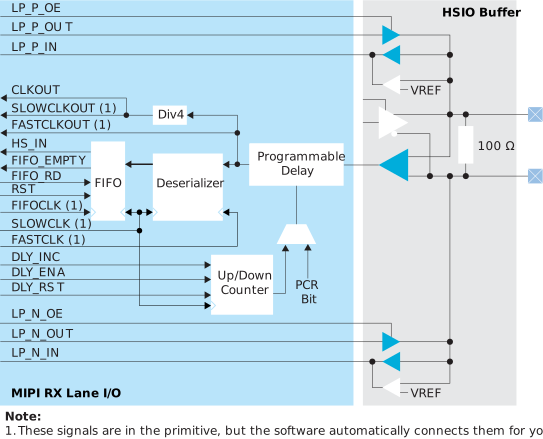
| Signal | Direction | Clock Domain | Description |
|---|---|---|---|
| LP_P_OE | Input | – | (Optional) LP output enable signal for P pad. |
| LP_P_OUT | Input | – | (Optional) LP output data from the core for the P pad. Used if the data lane is reversible. |
| LP_P_IN | Output | – | LP input data from the P pad. |
| CLKOUT | Output | – | Divided down parallel (slow) clock from the pads that can drive the core clock tree. Used to drive the core logic implementing the rest of the D-PHY protocol. It should also connect to the FIFOCLK of the data lanes. |
| SLOWCLKOUT1 | Output | – | Divided down parallel (slow) clock from the pads. Can only drive RX DATA lanes. |
| FASTCLKOUT1 | Output | – | Serial (fast) clock from the pads. Can only drive RX DATA lanes. |
| HS_IN[7:0] | Output | SLOWCLK | High-speed parallel data input. |
| FIFO_EMPTY | Output | FIFOCLK | (Optional) When the FIFO is enabled, this signal indicates that the FIFO is empty. |
| FIFO_RD | Input | FIFOCLK | (Optional) Enables FIFO to read. |
| RST | Input | FIFOCLK SLOWCLK |
(Optional) Asynchronous. Resets the FIFO and serializer. If the FIFO is enabled, it is relative to FIFOCLK; otherwise it is relative to SLOWCLK. |
| FIFOCLK1 | Input | – | (Optional) Core clock to read from the FIFO. |
| SLOWCLK1 | Input | – | Parallel (slow) clock. |
| FASTCLK1 | Input | – | Serial (fast) clock. |
| DLY_INC | Input | SLOWCLK | (Optional) Dynamic delay control. When DLY_ENA is 1, 1:
Increments 0: Decrements |
| DLY_ENA | Input | SLOWCLK | (Optional) Enable the dynamic delay control. |
| DLY_RST | Input | SLOWCLK | (Optional) Reset the delay counter. |
| LP_N_OE | Input | – | (Optional) LP output enable signal for N pad. |
| LP_N_OUT | Input | – | (Optional) LP output data from the core for the N pad. Used if the data lane is reversible. |
| LP_N_IN | Output | – | LP input data from the N pad. |
| HS_ENA | Input | – | Dynamically enable the differential input buffer when in high-speed mode. |
| HS_TERM | Input | – | Dynamically enables input termination high-speed mode. |
The clock lane generates the fast clock and slow clock for the RX data lanes within the interface group. It also generates a clock which is divided by 4 that feeds the global network. The following figure shows the clock connections between the clock and data lanes.
MIPI TX Lane
In TX mode, a PLL generates the parallel and serial clocks and passes them to the clock and data lanes.
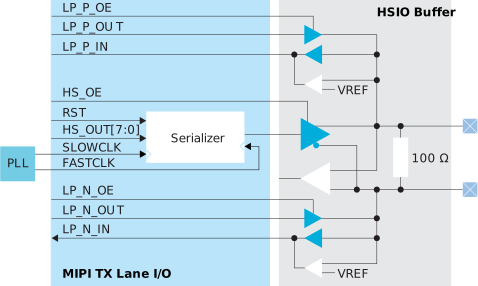
| Signal | Direction | Clock Domain | Description |
|---|---|---|---|
| LP_P_OE | Input | – | LP output enable signal for P pad. |
| LP_P_OUT | Input | – | LP output data from the core for the P pad. |
| LP_P_IN | Output | – | (Optional) LP input data from the P pad. Used if data lane is reversible. |
| HS_OE | Input | – | High-speed output enable signal. |
| RST | Input | SLOWCLK | (Optional) Resets the serializer. |
| HS_OUT[7:0] | Input | SLOWCLK | High-speed output data from the core. Always 8-bits wide. |
| SLOWCLK | Input | – | Parallel (slow) clock. |
| FASTCLK | Input | – | Serial (fast) clock. |
| LP_N_OE | Input | – | LP output enable signal for N pad. |
| LP_N_OUT | Input | – | LP output data from the core for the N pad. |
| LP_N_IN | Output | – | (Optional) LP input data from the N pad. Used if data lane is reversible. |
MIPI Lane Pads
| Signal | Direction | Description |
|---|---|---|
| P | Bidirectional | Differential pad P. |
| N | Bidirectional | Differential pad N. |