MIPI RX
The MIPI RX is a receiver interface that translates HSSI signals from the board to video data in the Trion® core. Five high-speed differential pin pairs (one clock, four data), each of which represent a lane, connect to the board. Control, video, and status signals connect from the MIPI interface to the core.
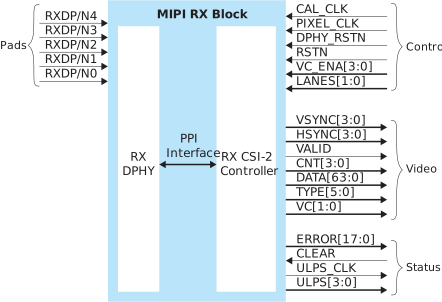
The control signals determine the clocking, how many transceiver lanes are used, and how many virtual channels are enabled. All control signals are required except the two reset signals. The reset signals are optional, however, you must use both signals or neither.
The video signals send the decoded video data to the core. All video signals must fully support the MIPI standard.
The status signals provide optional status and error information about the MIPI RX interface operation.

| Signal | Direction | Clock Domain | Notes |
|---|---|---|---|
| CAL_CLK | Input | N/A | Used for D-PHY calibration; must be between 80 and 120 MHz. |
| PIXEL_CLK | Input | N/A | Clock used for transferring data to the core from the MIPI RX
block. The frequency based on the number of lanes and video format.
Refer to Understanding the RX and TX Pixel Clock. |
| DPHY_RSTN | Input | N/A | (Optional) Reset for the D-PHY logic, active low. Must be used if
RSTN is used. See MIPI Reset Timing. |
| RSTN | Input | N/A | (Optional) Reset for the CSI-2 controller logic, active low. Must
be used if DPHY_RSTN is used. See MIPI Reset Timing. |
| VC_ENA[3:0] | Input | PIXEL_CLK | Enables different VC channels by setting their index high. |
| LANES[1:0] | Input | PIXEL_CLK | Determines the number of lanes enabled: 00: lane
0 01: lanes 0 and 1 11: all lanes Can only be set during reset. |
| Signal | Direction | Clock Domain | Notes |
|---|---|---|---|
| VSYNC[3:0] | Output | PIXEL_CLK | Vsync bus. High if vsync is active for this VC. |
| HSYNC[3:0] | Output | PIXEL_CLK | Hsync bus. High if hsync is active for this VC |
| VALID | Output | PIXEL_CLK | Valid signal. |
| CNT[3:0] | Output | PIXEL_CLK | Number of valid pixels contained in the pixel data. |
| DATA[63:0] | Output | PIXEL_CLK | Video data, format depends on data type. New data every pixel clock. |
| TYPE[5:0] | Output | PIXEL_CLK | Video data type. |
| VC[1:0] | Output | PIXEL_CLK | Virtual channel (VC). |
| Signal | Direction | Signal Interface | Clock Domain | Notes |
|---|---|---|---|---|
| ERROR[17:0] | Output | IN | PIXEL_CLK | Error bus register. Refer to Table 4 for details. |
| CLEAR | Input | OUT | PIXEL_CLK | Reset the error registers. |
| ULPS_CLK | Output | IN | PIXEL_CLK | High when the clock lane is in the Ultra-Low-Power State (ULPS). |
| ULPS[3:0] | Output | IN | PIXEL_CLK | High when the lane is in the ULPS mode. |
| Bit | Name | Description |
|---|---|---|
| 0 | ERR_ESC | Escape Entry Error. Asserted when an unrecognized escape entry command is received. |
| 1 | CRC_ERROR_VC0 | CRC Error VC0. Set to 1 when a checksum error occurs. |
| 2 | CRC_ERROR_VC1 | CRC Error VC1. Set to 1 when a checksum error occurs. |
| 3 | CRC_ERROR_VC2 | CRC Error VC2. Set to 1 when a checksum error occurs. |
| 4 | CRC_ERROR_VC3 | CRC Error VC3. Set to 1 when a checksum error occurs. |
| 5 | HS_RX_TIMEOUT_ERR | HS RX Timeout Error. The protocol should time out when no EoT is received within a certain period in HS RX mode. |
| 6 | ECC_1BIT_ERROR | ECC Single Bit Error. Set to 1 when there is a single bit error. |
| 7 | ECC_2BIT_ERROR | ECC 2 Bit Error. Set to 1 if there is a 2 bit error in the packet. |
| 8 | ECCBIT_ERROR | ECC Error. Asserted when an error exists in the ECC. |
| 9 | ECC_NO_ERROR | ECC No Error. Asserted when an ECC is computed with a result zero. This bit is high when the receiver is receiving data correctly. |
| 10 | FRAME_SYNC_ERROR | Frame Sync Error. Asserted when a frame end is not paired with a frame start on the same virtual channel. |
| 11 | INVLD_PKT_LEN | Invalid Packet Length. Set to 1 if there is an invalid packet length. |
| 12 | INVLD_VC | Invalid VC ID. Set to 1 if there is an invalid CSI VC ID. |
| 13 | INVALID_DATA_TYPE | Invalid Data Type. Set to 1 if the received data is invalid. |
| 14 | ERR_FRAME | Error In Frame. Asserted when VSYNC END received when CRC error is present in the data packet. |
| 15 | CONTROL_ERR | Control Error. Asserted when an incorrect line state sequence is detected. |
| 16 | SOT_ERR | Start-of-Transmission (SoT) Error. Corrupted high-speed SoT leader sequence while proper synchronization can still be achieved. |
| 17 | SOT_SYNC_ERR | SoT Synchronization Error. Corrupted high-speed SoT leader sequence while proper synchronization cannot be expected. |
| Pad | Direction | Description |
|---|---|---|
| RXDP[4:0] | Input | MIPI transceiver P pads. |
| RXDN[4:0] | Input | MIPI transceiver N pads. |
| Tab | Parameter | Choices | Notes |
|---|---|---|---|
| Control | DPHY Calibration Clock Pin Name | User defined | |
| Invert DPHY Calibration Clock | On or Off | ||
| Pixel Clock Pin Name | User defined | ||
| Invert Pixel Clock | On or Off | ||
| Status | Enable Status | On or Off | Indicate whether you want to use the status pins. |
| Lane Mapping | RXD0, RXD1, RXD2, RXD3, RXD4 | clk, data0, data1, data2, or data3 | Map the physical lane to a clock or data lane. |
| Swap P&N Pin | On or Off | Reverse the P and N pins for the physical lane. | |
| Timing | Calibration Clock Freq (MHz) | User defined | Specify a number between 80 and 120 MHz. |
| Clock Timer (TCLK-SETTLE) | 40 - 2,590 ns | Changes the MIPI receiver timing parameters per the DPHY specification. Refer to D-PHY Timing Parameters. | |
| Data Timer (THS-SETTLE) | 40 - 2,590 ns | Changes the MIPI receiver timing parameters per the DPHY specification. Refer to D-PHY Timing Parameters. |