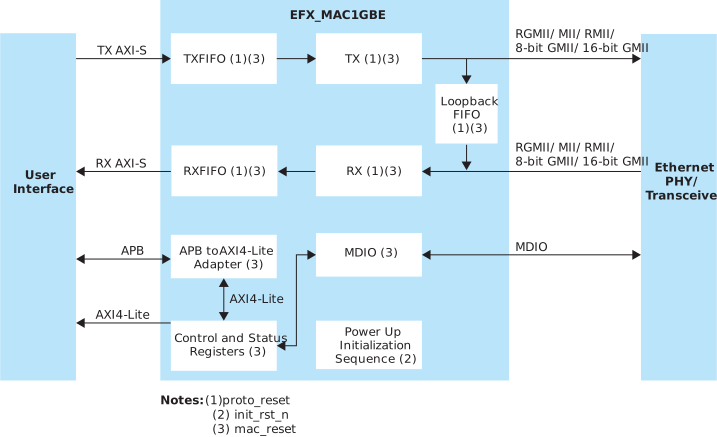
Reset Signals
The Triple Speed Ethernet MAC core has 3 reset signals. These signals are
asynchronous.
init_rst_n is active low, but mac_reset
and proto_reset are active high.mac_reset(Global Reset)proto_reset(Protocol Reset)init_rst_n(Initialization Reset)
During the FPGA power-up, intitalize
mac_reset and proto_reset to 1,
and init_rst_n to 0 to ensure the Triple Speed Ethernet MAC core is held in a known reset state.mac_reset(Global Reset)- Resets all logic within the Triple Speed Ethernet MAC core, including control and status registers.
- Only the power-up sequence module remains unaffected and operational.
proto_reset(Protocol Reset)- Resets both the TX and RX data paths, as well as the statistics counters.
- Does not affect the power-up sequence module.
init_rst_n(Initialization Reset)- Used when pairing the Triple Speed Ethernet MAC core with an FPGA transceiver in SGMII mode.
- Requires a free-running
init_clk. - Upon
IN_USER, deassertinit_rst_nto start the power-up handshake with the FPGA ransceiver. - Must remain deasserted throughout normal operation.
- Detailed power-up sequence is described in Power Up Handshake with FPGA Transceiver.
For synchronization reset, all three resets are asynchronous assertion or synchronous
deassertion.
init_rst_nis synchronized internally toinit_clk.mac_resetandproto_resetare synchronized internally to their respective clock domains.- Each reset synchronizer introduces a 2 – 3 clock cycle latency upon deassertion.
Note: To ensure proper operation after reset deasssertion, you must
delay data transmission by at least 3 clock cycles following the release of the reset
signal. This delay allows sufficient time for the internal reset synchronizers to
stabilize before any AXI4-Stream or PHY interface activity begins. Failure to observe
this delay may result in undefined behavior or corrupted frame transmission during the
startup process.
The Figure 1 shows the reset domains in the Triple Speed Ethernet MAC core.