Titanium About the SPI Flash Memory
Titanium FPGAs in the M225S4F4 package include a SPI flash memory. The SPI flash memory has a density of 256 Mbits and a clock rate of up to 166 MHz. You can fit four compressed bitstream images into the SPI flash.
Some packages include one or more HyperRAM devices. Refer to the data sheet for the flash density and clock rate.
In SPI active configuration mode, the FPGA is configured using a bitstream stored in the SPI flash device. During configuration, the maximum clock frequency for the flash device is specified in SPI Active Mode. When the FPGA is in user mode, you can access the flash at the flash device's maximum clock frequency (although different SPI flash commands may have different maximum clock frequencies).
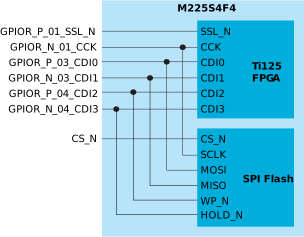
VCCIO_3B. If you are using the SPI flash
memory, drive the VCCIO_3B with a 1.8 V supply.| SPI Name | Signal | Direction | Description |
|---|---|---|---|
| SCLK | SCLK_OUT | Input | Clock output from FPGA CCK pin to SPI flash memory. |
| SCLK_OE | Input | Output enable. Required for multiple controller. | |
| MOSI | MOSI_IN | Output | Required for ×2 or ×4 data width. |
| MOSI_OUT | Input | Data output from FPGA CDI0 to SPI flash memory. | |
| MOSI_OE | Input | Output enable. Required for ×2 data width, ×4 data width, or multiple controller. | |
| MISO | MISO_IN | Output | Data input to FPGA CDI1 from SPI flash memory. |
| MISO_OUT | Input | Required for ×2 or ×4 data width. | |
| MISO_OE | Input | Output enable. Required for ×2 or ×4 data width. | |
| WP_N | WP_N_IN | Output | Required for ×4 data width. |
| WP_N_OUT | Input | Data output from FPGA CDI2 pin to SPI flash memory. | |
| WP_N_OE | Input | Output enable. Required for ×4 data width or multiple controller. | |
| HOLD_N | HOLD_N_IN | Output | Required for ×4 data width. |
| HOLD_N_OUT | Input | Data output from FPGA CDI3 pin to SPI flash memory | |
| HOLD_N_OE | Input | Output enable. Required for ×4 data width or multiple controller. | |
| CS_N | CS_N_OUT | Input | Chip select output from FPGA SSL_N pin to SPI flash memory. |
| CS_N_OE | Input | Output enable. Required for multiple controller. | |
| CLK | CLK | Input | Required for register interface. |
- SPI Active using JTAG Bridge mode
- SPI Active mode
The
GPIOR_P_01
(SSL_N),
GPIOR_N_01
(CCK),
GPIOR_P_03
(CDI0), and
GPIOR_N_03
(CDI1) resources are for the SPI active interface. You can use
these signals to read/write user data to/from the SPI flash memory while the Titanium
FPGA is in user mode. You enable this feature by adding the SPI
flash block to your interface design. These resources are not available as user I/O pins
if you use the SPI flash block.
You can also write a new bitstream to the SPI flash memory by controlling the SPI signals
with an external controller. In this case, the CRESET_N signal should
stay low and the FPGA remains in reset mode, even though you
stored a new bitstream in the SPI flash memory. To enable this mode, turn on in the Interface Designer.
| Option | Choices | Notes |
|---|---|---|
| Instance Name | User defined | |
| SPI Flash Resource | SPI_FLASH0 | Only one resource available. |
| Enable Register Interface | 0, 1 | Default: 0 (Disable) |
| Read/Write Width | x1, x2, x4 | Default: x1 |
| Enable Multiple Controller | 0, 1 | Default: 0 (Disable) |
| Pin names (various) | User defined | Specify the interface pin names. |