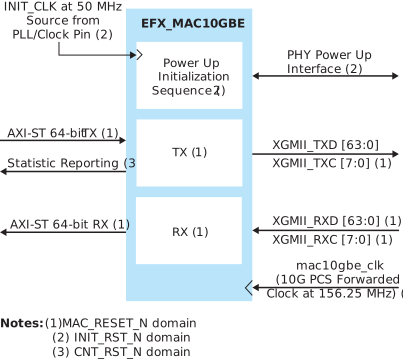
Reset Signals
init_rst_nmac_reset_ncnt_rst_n
During the FPGA power-up, all three reset signals must be initialized to 0 to reset the entire Ethernet 10G MAC core to its initial known state.
The init_clk signal needs to be sourced and free-running. When the
FPGA is in user mode, you need to deassert
init_rst_n to kick-start the power-up sequence with the FPGA PHY. The init_rst_n signal is to remain
deasserted throughout the operation. Details of the power-up sequence are being
described in Power Up Handshake with FPGA Transceiver.
When mac_reset_n is asserted, it resets the core logic of the Ethernet 10G MAC core, including TX and RX, and
statistic reporting. The power-up sequence module remains intact and operational.
When cnt_rst_n is asserted, it resets all the statistic reporting in TX
and RX. Except for the statistic counters, the logic of the Ethernet 10G MAC core remains operational. The
power-up sequence module remains intact.
These 3 reset signals are asynchronous, but the deassertion of each reset signals is
synchronous. For init_rst_n, there is an internal reset synchronizer to
align the deassertion of init_rst_n to init_clk. For
mac_reset_n and cnt_rst_n, there is a respective
internal reset synchronizer to synchronize the deassertion of
mac_reset_n and cnt_rst_n to
mac10gbe_clk.
Each reset synchronizer has a latency of 2 to 3 clock cycles.
The Figure 1 shows the reset domains in the Ethernet 10G MAC core.