Signal_ok
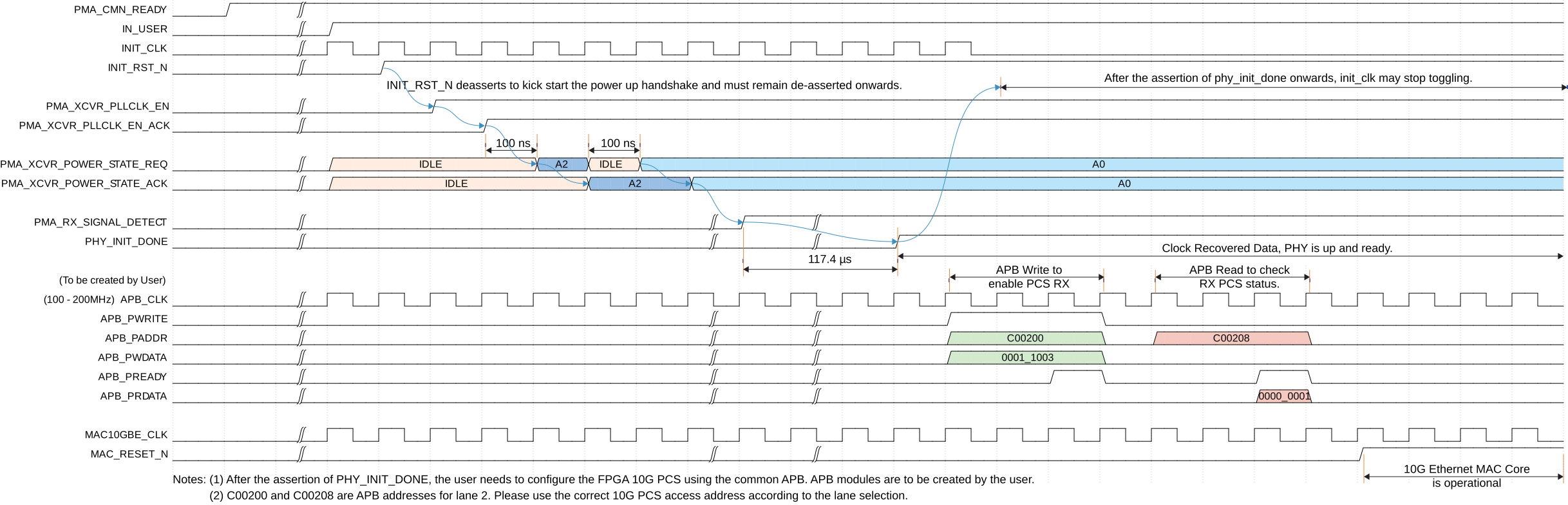
After the assertion of phy_init_done, you must create an APB driver to
configure signal_ok, based on the register mapping in the Register Map
chapter (refer to control_register table, status_register table, and
interrupt_status_register table) of the Titanium Ethernet 10GBase-KR User Guide. The APB
interface is a common interface shared across all 4 lanes within a quad. The
signal_ok enables the RX path in the FPGA Ethernet 10G PCS. Figure 1 includes an illustration of APB
Write to enable PCS RX in Lane 2.
Any deassertion of phy_init_done signals that the current
CDR-locked-to-data condition has lost lock. When this occurs, you must set the
signal_ok to 0 to disable the RX path in the
FPGA Ethernet 10G PCS. Upon the recovery of
phy_init_done, you must reconfigure the signal_ok
to 1 to re-enable the RX path in the FPGA
Ethernet 10G PCS.
PMA_CMN_READY signal deasserts, it indicates that the FPGA transceiver PHY is no longer functional. If this occurs, all
the per-lane reset input signals (i.e., init_rst_n,
mac_reset_n, and cnt_rst_n) must be asserted. You must set
the signal_ok to 0 to disable the RX path in the
FPGA Ethernet 10G PCS. Once the FPGA PHY recovers from reset, you must repeat the entire power-up
handshake by deasserting the init_rst_n to start over the power-up
sequence.phy_init_done, PMA_CMN_READY,
PCS_RST_N_TX, or PCS_RST_N_TX (both the latter
signals are from FPGA Ethernet 10G PCS).