Dynamic Reconfiguration for Configuration Register
The HyperRAM Controller core allows you to perform configuration register read or write to the HyperRAM. To use the dynamic reconfiguration feature, select Enable on Dynamic Reconfiguration in Memory Register tab. This is only available with IP version v6.12 or above.
To perform dynamic reconfiguration, you need to write the specific address into the user interface, this address is different depending on the type of HyperRAM and the type of user interface (AXI or Native). You can refer to Table 1 and Table 2.
| Type of HyperRAM Configuration | Register Write
Address (io_arw_payload_write == 1) |
Register Read
Address (io_arw_payload_write == 0) |
||
|---|---|---|---|---|
| CR0 | CR1 | CR0 | CR1 | |
| x8 | 32’h80001000 | 32’h80001002 | 32’h80001000 | 32’h80001002 |
| x16 | 32’h80002000 | 32’h80002004 | 32’h80002000 | 32’h80002004 |
| 2x8 (Dual HyperRAM) | 32’h80002000 | 32’h80002004 | 32’h80002000 | 32’h80002004 |
| 2x16 (Dual HyperRAM) | 32’h80004000 | 32’h80004008 | 32’h80004000 | 32’h80004008 |
| Type of HyperRAM Configuration | Register Write Address (native_ram_rdwr
== 0) |
Register Read Address (native_ram_rdwr
== 1) |
||
|---|---|---|---|---|
| CR0 | CR1 | CR0 | CR1 | |
| x8 | 32’hC0000800 | 32’hC0000801 | 32’hC0000800 | 32’hC0000801 |
| x16 | 32’hC0000800 | 32’hC0000801 | 32’hC0000800 | 32’hC0000801 |
| 2x8 | 32’hC0000800 | 32’hC0000801 | 32’hC0000800 | 32’hC0000801 |
| 2x16 | 32’hC0000800 | 32’hC0000801 | 32’hC0000800 | 32’hC0000801 |
The length of the data sent must be the smallest length for the data width. Refer to Table 3 for the length value needed for each configuration.
| User Interface | Dual HyperRAM | Data Width | Length | Burst Type |
|---|---|---|---|---|
| AXI | No | 256 | 0 | 01 (Linear burst) |
| 128 | 0 | 01 (Linear burst) | ||
| 64 | 0 | 01 (Linear burst) | ||
| 32 | 0 | 01 (Linear burst) | ||
| Native | No | 128 | 4 | Linear burst |
| 64 | 2 | Linear burst | ||
| 32 | 1 | Linear burst | ||
| Yes | 128 | 2 | Linear burst | |
| 64 | 1 | Linear burst |
When performing register write, the content that is written to
io_w_payload_data or native_wr_data must follow
the pattern in Table 4.
| HyperRAM Width | Expected Read Data (User Interface) | Example Read Data User Width = 64 with default CR0
content |
|---|---|---|
| x8 | {User Width/16 {CR[15:0]}} | 64’h 8f2f 8f2f 8f2f 8f2f |
| x16 | {User Width/32 {‘h00, CR[15:8], ‘h00, CR[7:0] }} | 64’h 008f 002f 008f 002f |
| Type of HyperRAM Configuration | User Input on User Channel (CR = Configuration
Register) |
Example Write Data User Width = 64 with deep power
down |
|---|---|---|
| x8 | {User_Width/16 { CR[15:8], CR[7:0], CR[15:8], CR[7:0] }} | 64’h 0f2f 0f2f 0f2f 0f2f |
| x16 | {User_Width/32 {CR[15:8], CR[15:8], CR[7:0], CR[7:0] }} | 64’h000f 002f 000f 002f |
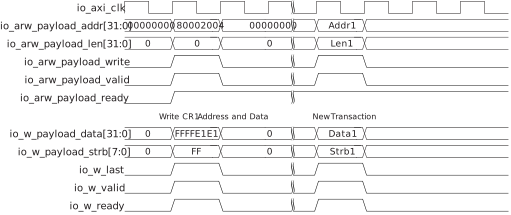
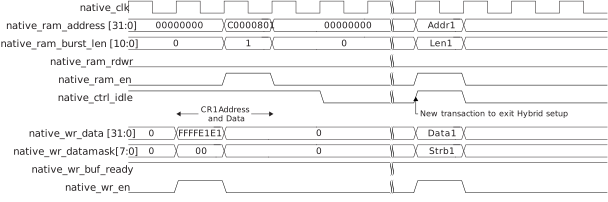
Figure 1 and Figure 2 show an example of register write to trigger hybrid sleep. To exit hybrid sleep or deep power down, request a new transaction, and the HyperRAM Controller core IP handles the exit sequence.