AN 070: Understanding SPI Flash Operations in SIP Devices
Introduction
Efinix® provides some FPGAs as SIPs, in which the FPGA is combined with another device, such as flash memory. SIPs that include flash memory make it easy for you to integrate the FPGA on your board because you do not need to include a flash device. Instead, the FPGA configures itself from the flash memory in the package. This application note explains how to use the flash device in SIP packages.
Feature Summary
The following table outlines the range of SPI flash features available in Efinix FPGA’s with SIP devices.
| Device | SPI Active (Internal Flash) | SPI Passive | Cascade SPI Flash on the same SPI Bus | 4-Byte Addressing | Number of Images that can be Stored |
|---|---|---|---|---|---|
| T13Q100F3, T20Q100F3 | x4 | x16 | Supported | Not Supported | 4 |
| Ti135F100S3F2, Ti60F100S3F2 | x4 | x2 | Not Supported | Not Supported | 2 |
| Ti135N576D2F4 | x4 | x32 | Supported | Supported | 4 |
SPI Flash Block Interface Features
The T20 and Ti60 comes with 2 MB of SPI flash. The following table outlines the signal connection between the SPI flash interface and FPGA fabric.
| SPI Name | FPGA Pin | Interface to FPGA Fabric | ||||
|---|---|---|---|---|---|---|
| x1 Mode (default) | x2 Mode | x4 Mode | Fabric Signal | Fabric Direction | ||
| SPI_CS_N | SSL_N | Input | Input | Input | CS_N_OUT | Input |
| CS_N_OE | Input | |||||
| SPI_SCLK | CCK | Input | Input | Input | SCLK_OUT | Input |
| SCLK_OE | Input | |||||
| SPI_MOSI | CDI0 | Input | Input/Output | Input/Output | MOSI_IN | Output |
| MOSI_OUT | Input | |||||
| MOSI_OE | Input | |||||
| SPI_MISO | CDI1 | Output | Input/Output | Input/Output | MISO_IN | Output |
| MISO_OUT | Input | |||||
| MISO_OE | Input | |||||
| SPI_WP | CDI2 | Input | Input | Input/Output | WP_N_IN | Output |
| WP_N_OUT | Input | |||||
| WP_N_OE | Input | |||||
| SPI_HOLD_N | CDI3 | Input | Input | Input/Output | HOLD_N_IN | Output |
| HOLD_N_OUT | Input | |||||
| HOLD_N_OE | Input | |||||
Refer to SPI flash section of data sheets for supported commands, registers, and address mapping.
The following table shows the Status Register bits supported by the device.
| Bit | Name | Description | Non-Volatile | Write | Read |
|---|---|---|---|---|---|
| 01 | WIP | 1: Indicating whether the memory is busy in program/erase/write status register progress. |  |
||
| 11 | WEL | 1: Enable to accept write commands (Write Status Register, Program, or Erase command). | |
|
|
| 61 – 21 | BP[4:0] | The Block Protect bits define the size of the area to be software protected against Program and Erase commands | |
|
|
| 82 – 71 | SRP[1:0] | The SRP bits control the method of write protection | |
|
|
| 00: Status register S23 – S0 can be written to after a Write Enable command (0x06), | |||||
| 01: Hardware Protected: WP_N=0: Status registers are locked
and cannot be written to. WP_N=1: Status registers are
unlocked and can be written to after a Write Enable command
(0x06). Note: If QE bit is set to 1,
WP# pin will not function. |
|||||
| 10: Command, WEL=1. Power Supply Lock-Down: Status Registers
are protected and cannot be written to again until the next
Power up cycle. |
|||||
| 11: Not supported | |||||
| 92 | QE | The Quad Enable (QE) bit allows quad operation. When the QE bit
is set to 0 (Default) the WP# pin and HOLD# pin are enabled.
When the QE pin is set to 1, the quad IO2 and IO3 pins are
enabled. |
|
|
|
| 102 | – | Not available | |
||
| 132 – 112 | LB[3:1] | The LB3–LB1bits are one-time programmable. When set to 1, the Security Registers are permanently set to read-only. | OTP | |
|
| 142 | CMP | Used in conjunction with bits BP4-BP0 to provide greater flexibility for array protection. | |
|
|
| 152 | SUS | 1: After executing an Program/Erase Suspend (75H) command.
0: By Program/Erase Resume (7AH) command, as well as a
power-down, power-up cycle. |
|
||
| 163 | – | Not available (Set to 0) | |
||
| 173 | – | Not available (Set to 0) | |
||
| 183 | WPS | 0 (default): The device uses the combination of CMP and BP[4:0]
bits to protect a specific area of the memory array. 1: The
device uses the individual block locks to protect any individual
sector or blocks. |
|
|
|
| 193 | – | Not available (Set to 0) | |
||
| 203 | – | Not available (Set to 0) | |
||
| 213 | – | Not available (Set to 0) | |
||
| 223 | – | Not available (Set to 0) | |
||
| 233 | HOLD/RST | 0: The pin acts as /HOLD 1: The pin acts as /RESET.
QE is set to 1, the /HOLD and /RESET functions are
disabled, the pin acts as a dedicated data I/O pin.
|
|
|
|
SPI Flash Block Interface Support Devices
This section describes the SPI flash interface for Efinix system-in-package (SIP) FPGAs that include an internal SPI flash device.
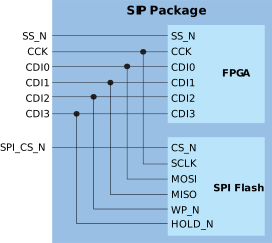
Packages with CS_N
Trion FPGAs in QFP100F3 packages are a system-in-package (SIP) that includes an internal SPI flash device.
The SPI flash memory VCC is powered by VCCIO1A_1B_1C (3.3 V)4. The
following figure shows the internal connections and pin assignment. The SPI flash memory
stores the configuration bitstream for FPGA SPI active
configurations. The SPI flash device is used to store the bitstream. Additionally, in
user mode, the SPI flash device can store data sent to it by the FPGA. For a more detailed overview of FPGA
hardware design and configuration, refer to AN 006: Configuring Trion FPGAs. The CS pin of the
internal SPI flash device is an individual pin in the package. Connect the pin to
GPIOL_00_SS_N on the board design if you intend to use the internal
flash.
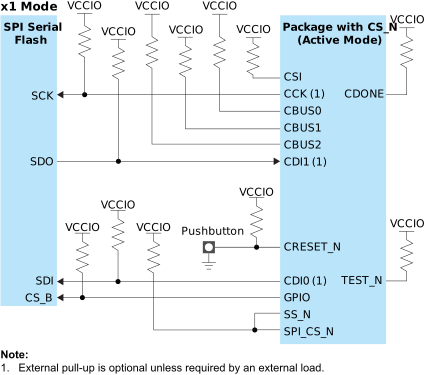

- Drive
SS_Nto low - Drive
CRESET_Nto low.
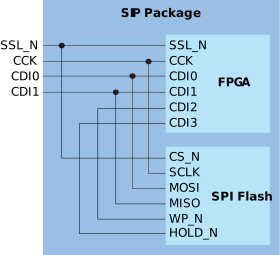
Packages without CS_N
Titanium FPGAs in F100F3S2 packages are a system-in-package (SIP) that includes an internal SPI flash device.
The SPI flash memory VCC is connected to VCCIO1A_4B. If you are using
the SPI flash memory, drive the VCCIO1A_4B with a 1.8 V supply. The
following figure shows the internal connections and pin assignment. The SPI flash memory
stores the configuration bitstream for FPGA SPI active
configurations. The SPI flash device is used to store the bitstream. Additionally, in
user mode, the SPI flash device can store data sent to it by the FPGA. For a more detailed overview of FPGA
hardware design and configuration, refer to AN 033: Configuring Titanium FPGAs.
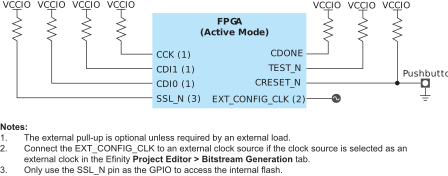
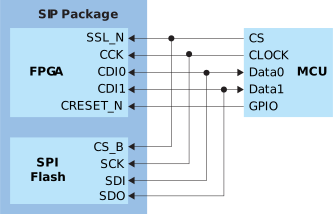
- Drive
SSL_Nto low - Drive
CRESET_Nto low.
Timing and AC Characteristics
The following figures show the timing of serial input/output data transmitted between the FPGA interface (master) and SPI flash device, as well as corresponding AC characteristics.


| Symbol | Parameter | VCC = 1.8 V5 | VCC = 3.3 V6 | Unit | ||||
|---|---|---|---|---|---|---|---|---|
| Min. | Typ. | Max. | Min. | Typ. | Max. | |||
| fSCLK | Clock Frequency | 33 | 55 | MHz | ||||
| tCLL | Clock High Time | 5.5 | 3.3 | ns | ||||
| tCLH | Clock Low Time (fSCLK) 45% x (1fSCLK) | 5.5 | 3.3 | ns | ||||
| tCLQX | Output Hold Time | 0 | 0 | ns | ||||
| tCLQV | Clock Low to Output Valid Loading | 7 | 7 | ns | ||||
| tSHQZ | Output Disable Time | 6 | 6 | ns | ||||
| tCHSL | CS# Not Active Hold Time (Relative to SCLK) | 5 | 5 | ns | ||||
| tSLCH | CS# Active Setup Time (Relative to SCLK) | 5 | 5 | ns | ||||
| tDVCH | Data in Setup Time | 2 | 2 | ns | ||||
| tCHDX | Data in Hold Time | 3 | 3 | ns | ||||
| tCLCH | Clock Rise Time (Peak to Peak) | 0.1 | 0.1 | V/ns | ||||
| tCHCL | Clock Fall Time (Peak to Peak) | 0.1 | 0.1 | V/ns | ||||
| tSHSL | CS# Deselect Time from Read to next Read | 20 | 20 | ns | ||||
| tSHSL | CS# Deselect Time From Write, Erase, Program to Read Status Register | 30 | 30 | ns | ||||
| tCHHL | HOLD# Not Active Hold Time (Relative to SCLK) | 5 | 5 | ns | ||||
| tHLCH | HOLD# Active Setup Time (Relative to SCLK) | 5 | 5 | ns | ||||
| tCHHH | HOLD# Active Hold Time (Relative to SCLK) | 5 | 5 | ns | ||||
| tHHCH | HOLD# Not Active Setup Time (Relative to SCLK) | 5 | 5 | ns | ||||
| tHLQZ | HOLD# to Output High-Z | 6 | 6 | ns | ||||
| tHHQX | Output Hold Time | 6 | 6 | ns | ||||
| tWHSL | Write Protect Setup Time | 20 | 20 | ns | ||||
| tSHWL | Write Protect Hold Time | 100 | 100 | ns | ||||
| tDP | CS# High to Deep Power-down Mode | 3 | 3 | us | ||||
| tRES1 | CS# High to Standby Mode without Electronic Signature Read | 8 | 8 | us | ||||
| tRES2 | CS# High to Standby Mode with Electronic Signature Read | 8 | 8 | us | ||||
| tW | Write Status Register Cycle Time | 8 | 12 | 8 | 12 | ms | ||
| tReady | Reset Recovery Time (for erase/program operation except WRSR) | 30 | 30 | us | ||||
| Reset Recovery Time (for WRSR operation) | 12 | 8 | 12 | 8 | ms | |||
| tBL | Load memory page data to buffer time (256 Byte) | 60 | 60 | us | ||||
| Load memory page data to buffer time (512 Byte) | 120 | 120 | us | |||||
| tBC | Buffer clear to next instruction latency | 300 | 200 | ns | ||||
The following waveforms show the timing of hold and WP between the FPGA interface (master) and SPI flash device, as well as corresponding AC characteristics as shown previously.


The following table shows the timing of Program and Erase command operations.
| Symbol | Parameter | VCC = 1.8 V7 | VCC = 3.3 V8 | Unit | ||||
|---|---|---|---|---|---|---|---|---|
| Min. | Typ. | Max. | Min. | Typ. | Max. | |||
| TESL | Erase Suspend Latency | 30 | 30 | us | ||||
| TPSL | Program Suspend Latency | 30 | 30 | us | ||||
| TPRS | Latency between Program Resume and Next Suspend | 20 | 20 | us | ||||
| TERS | Latency between Erase Resume and next Suspend | 20 | 20 | us | ||||
| tPP | Page program time (up to 256 bytes) | 2 | 3 | 1.5 | 3 | ms | ||
| tPE | Page erase time | 16 | 20 | 16 | 30 | ms | ||
| tSE | Sector erase time | 16 | 20 | 16 | 30 | ms | ||
| tBE1 | Block erase time for 32K bytes | 16 | 20 | 16 | 30 | ms | ||
| tBE2 | Block erase time for 64K bytes | 16 | 20 | 16 | 30 | ms | ||
| tCE | Chip erase time | 130 | 180 | 130 | 180 | ms | ||
Supported Commands
Use the commands in the following table to perform flash device operations (e.g., read, write). Memory access supports 24-bit addressing, with byte addresses assigned via the address frame. The first byte on the frame is at the address [23:16], followed by address [15:8], and with the last byte at address [7:0]. All serial input and output timing frames for standard SPI commands rely on x1 mode timing.
For dual SPI commands, some serial input/output timings rely on x2 mode timing. Pins
SPI_MOSI and SPI_MISO are used for either serial
input or output. SPI_WP and SPI_HOLD pin functions are
available.
For quad SPI commands, some serial input /output timings rely on x4 mode timing.
SPI_MOSI, SPI_MISO, SPI_WP and
SPI_HOLD are used for either serial input or output. The QE bit of
the status registers must be set to 1 before issuing any quad SPI commands. Also, be
aware the functions of the SPI_WP and SPI_HOLD pins
are unavailable while the QE bit is set to 1.
| Commands | Description | Value / Number of Bytes (Mode) | ||||
|---|---|---|---|---|---|---|
| Op Code (Command) | Address | Dummy | Data Input | Data Output | ||
| Status Register | ||||||
| Read Status Register | Read Status Register Bit S7 – S0 | 05h (x1) |
S7 – S0 (x1) |
|||
| Read Status Register-1 | Read Status Register Bit S15 – S8 | 35h (x1) |
S15 – S8 (x1) |
|||
| Read Configure Register-2 | Read Status Register Bit S23 – S16 | 15h (x1) |
S23 – S16 (x1) |
|||
| Write Status Register | Write to Status Register Bits S7 – S0 | 01h (x1) |
S7 – S0 (x1) |
|||
| Write Status Register-1 | Write to Status Register Bits S15 – S8 | 31h (x1) |
S15 – S8 (x1) |
|||
| Write Configure Register-2 | Write to Status Register Bits S23 – S16 | 11h (x1) |
S23 – S16 (x1) |
|||
| Read | ||||||
| Read Array | n Bytes Read Until CS# Goes High | 03h (x1) |
3 (x1) |
1+ (x1) |
||
| Read Array (Fast) | n Bytes Read Until CS# Goes High | 0Bh (x1) |
3 (x1) |
1 (x1) |
1+ (x1) |
|
| Read Manufacturer/Device ID | Output JEDEC ID: 1-Byte Manufacturer ID 2-Byte Device
ID |
9Fh (x1) |
1 – 3 (x1) |
|||
| Read Manufacture ID | Read Manufacturer ID (Odd Address) and Device ID (Even Address) | 90h (x1) |
3 (x1) |
1+ (x1) |
||
| Erase/Program | ||||||
| Page Erase | Erase Selected Page | 81h (x1) |
3 (x1) |
|||
| Sector Erase (4K Bytes) | Erase Selected Sector | 20h (x1) |
3 (x1) |
|||
| Block Erase (32K Bytes) | Erase Selected 32K Block | 52h (x1) |
3 (x1) |
|||
| Block Erase (64K Bytes) | Erase Selected 64K Block | D8h (x1) |
3 (x1) |
|||
| Chip Erase | Erase Whole Chip | 60h/C7h (x1) |
||||
| Page Program | Program Selected Page | 02h (x1) |
3 (x1) |
1 – 256 (x1) |
||
| Program/Erase Suspend | Suspend Program/erase Operation | 75h (x1) |
||||
| Program/Erase Resume | Suspend Program/Erase Operation | 7Ah (x1) |
||||
| Protection | ||||||
| Write Enable | Sets Write Enable Latch Bit S1 WEL = 1 | 06h (x1) |
||||
| Write Disable | Resets Write Enable Latch Bit S1 WEL = 0 | 04h (x1) |
||||
| Volatile SR Write Enable | Write Enable for Volatile SR | 50h (x1) |
||||
| Individual Block Lock | Individual Block Lock | 36h (x1) |
3 (x1) |
|||
| Individual Block Unlock | Individual Block Lock | 39h (x1) |
3 (x1) |
|||
| Read Block Lock Status | Read Individual Block Lock Register | 3Dh (x1) |
3 (x1) |
1+ (x1) |
||
| Global Block Lock | Whole Chip Block Protect | 7Eh (x1) |
||||
| Global Block Unlock | Whole Chip Block Unprotect | 98h (x1) |
||||
| Security | ||||||
| Erase Security Registers | Erase Security Registers | 44h (x1) |
3 (x1) |
|||
| Program Security Registers | Program Security Registers | 42h (x1) |
3 (x1) |
1+ (x1) |
||
| Read Security Registers | Read Value of Security Registers | 48h (x1) |
3 (x1) |
1+ (x1) |
||
| Others (Standard SPI) | ||||||
| Reset Enable | Enable Reset | 66h (x1) |
||||
| Reset | Enable Reset | 99h (x1) |
||||
| Deep Power Down | Enters Deep Power-Down Mode | B9h (x1) |
||||
| Release Deep Power - Down/ Read Electronic ID
|
Read Electronic ID Data | Abh (x1) |
3 (x1) |
1 (x1) |
||
| Read SFDP | Read SFDP Parameter (SFDP is a JEDEC Standard, JESD216B) | 5Ah (x1) |
3 (x1) |
1 (x1) |
1+ (x1) |
|
| Commands | Description | Value / Number of Bytes (Mode) | ||||
|---|---|---|---|---|---|---|
| Op Code (Command) | Address | Dummy | Data Input | Data Output | ||
| Read (Dual SPI) | ||||||
| Read Dual Output | n Bytes Read by Dual Output | 3Bh (x1) |
3 (x1) |
1 (x1) |
1+ (x2) |
|
| Read 2IO | n Bytes Read by 2IO | BBh (x1) |
3 (x2) |
1 (x1) |
1+ (x1) |
|
| Dual Read Manufacture ID | Dual Output Manufacture (Odd)/Device ID (Even) | 92h (x1) |
3 (x2) |
1+ (x2) |
||
| Read (QUAD SPI) | ||||||
| Read QUAD Output | n bytes read out by quad output | 6Bh (x1) |
3 (x1) |
1 (x1) |
1+ (x4) |
|
| Read 4IO | n Bytes Read by 4IO | Ebh (x1) |
3 (x4) |
3 (x4) |
1+ (x4) |
|
| Read Word 4IO | n Bytes Word Read by 4IO | E7h (x1) |
3 (x4) |
1 (x4) |
1+ (x4) |
|
| Quad Read Manufacture ID | Quad Output Manufacture (Odd)/Device ID (Even Address) | 94h (x1) |
3 (x4) |
1+ (x4) |
||
| Erase / Program (QUAD SPI) | ||||||
| Quad Page Program | Quad Input to Program Selected Page | 32h (x1) |
3 (x1) |
1 – 256 (x4) |
||
Data Protection
The BP[4:0] and CMP WPS status registers are used to define protected areas of memory. Any commands, whether issued manually by automated by software, to change or erase the content of these protected memory blocks is ignored. These protected memory blocks are listed in the following tables.
| Status Bit | Memory Content | Portion | |||||||
|---|---|---|---|---|---|---|---|---|---|
| BP4 | BP3 | BP2 | BP1 | BP0 | Blocks | Addresses | Density | ||
| Start | End | ||||||||
| x | x | 0 | 0 | 0 | – | – | – | – | – |
| 0 | 0 | 0 | 0 | 1 | 31 | 1F0000 | 1FFFFF | 64 KB | Upper 1/32 |
| 0 | 0 | 0 | 1 | 0 | 30 – 31 | 1E0000 | 1FFFFF | 128 KB | Upper 1/16 |
| 0 | 0 | 0 | 1 | 1 | 28 – 31 | 1C0000 | 1FFFFF | 256 KB | Upper 1/8 |
| 0 | 0 | 1 | 0 | 0 | 24 – 31 | 180000 | 1FFFFF | 512 KB | Upper 1/4 |
| 0 | 0 | 1 | 0 | 1 | 16 – 31 | 100000 | 1FFFFF | 1 MB | Upper 1/2 |
| 0 | 1 | 0 | 0 | 1 | 0 | 000000 | 00FFFF | 64 KB | Lower 1/32 |
| 0 | 1 | 0 | 1 | 0 | 0 – 1 | 000000 | 01FFFF | 128 KB | Lower 1/16 |
| 0 | 1 | 0 | 1 | 1 | 0 – 3 | 000000 | 03FFFF | 256 KB | Lower 1/8 |
| 0 | 1 | 1 | 0 | 0 | 0 – 7 | 000000 | 07FFFF | 512 KB | Lower 1/4 |
| 0 | 1 | 1 | 0 | 1 | 0 – 15 | 000000 | 0FFFFF | 1 MB | Lower 1/2 |
| x | x | 1 | 1 | x | 0 – 31 | 000000 | 1FFFFF | 2 MB | All |
| 1 | 0 | 0 | 1 | 1 | 31 | 1FF000 | 1FFFFF | 4 KB | Upper 1/512 |
| 1 | 0 | 1 | 0 | 0 | 31 | 1FE000 | 1FFFFF | 8 KB | Upper 1/256 |
| 1 | 0 | 1 | 0 | 1 | 31 | 1FC000 | 1FFFFF | 16 KB | Upper 1/128 |
| 1 | 0 | 1 | 0 | x | 31 | 1F8000 | 1FFFFF | 32 KB | Upper 1/64 |
| 1 | 1 | 0 | 1 | 1 | 0 | 000000 | 000FFF | 4 KB | Lower 1/512 |
| 1 | 1 | 1 | 0 | 0 | 0 | 000000 | 001FFF | 8 KB | Lower 1/256 |
| 1 | 1 | 1 | 0 | 1 | 0 | 000000 | 003FFF | 16 KB | Lower 1/128 |
| 1 | 1 | 1 | 0 | x | 0 | 000000 | 007FFF | 32 KB | Lower 1/64 |
| Status Bit | Memory Content | Portion | |||||||
|---|---|---|---|---|---|---|---|---|---|
| BP4 | BP3 | BP2 | BP1 | BP0 | Blocks | Addresses | Density | ||
| Start | End | ||||||||
| x | x | 0 | 0 | 0 | 0 – 31 | 0 | 1FFFFF | 2 MB | All |
| 0 | 0 | 0 | 0 | 1 | 0 – 30 | 000000 | 1EFFFF | 1984 KB | Lower 31/31 |
| 0 | 0 | 0 | 1 | 0 | 0 – 29 | 000000 | 1DFFFF | 1920 KB | Lower 15/16 |
| 0 | 0 | 0 | 1 | 1 | 0 – 27 | 000000 | 1BFFFF | 1792 KB | Lower 7/8 |
| 0 | 0 | 1 | 0 | 0 | 0 – 23 | 000000 | 17FFFF | 1536 KB | Lower 3/4 |
| 0 | 0 | 1 | 0 | 1 | 0 – 15 | 000000 | 0FFFFF | 1 MB | Lower 1/2 |
| 0 | 1 | 0 | 0 | 1 | 1 – 31 | 010000 | 1FEFFF | 1984 KB | Upper 31/31 |
| 0 | 1 | 0 | 1 | 0 | 2 – 31 | 020000 | 1FEFFF | 1920 KB | Upper 15/16 |
| 0 | 1 | 0 | 1 | 1 | 4 – 31 | 0400000 | 1FEFFF | 1792 KB | Upper 7/8 |
| 0 | 1 | 1 | 0 | 0 | 8 – 31 | 080000 | 1FEFFF | 1536 KB | Upper 3/4 |
| 0 | 1 | 1 | 0 | 1 | 16 – 31 | 100000 | 1FEFFF | 1 MB | Upper 1/2 |
| x | x | 1 | 1 | x | – | – | – | – | – |
| 1 | 0 | 0 | 0 | 1 | 0 – 31 | 000000 | 1FEFFF | 2044 KB | Lower 511/512 |
| 1 | 0 | 0 | 1 | 0 | 0 – 31 | 000000 | 1FDFFF | 2040 KB | Lower 255/256 |
| 1 | 0 | 0 | 1 | 1 | 0 – 31 | 000000 | 1FBFFF | 2032 KB | Lower 127/128 |
| 1 | 0 | 1 | 0 | x | 0 – 31 | 000000 | 1F7FFF | 2016 KB | Lower 63/64 |
| 1 | 1 | 0 | 0 | 1 | 0 – 31 | 001000 | 1FFFFF | 2044 KB | Upper 511/512 |
| 1 | 1 | 0 | 1 | 0 | 0 – 31 | 002000 | 1FFFFF | 2040 KB | Upper 255/256 |
| 1 | 1 | 0 | 1 | 1 | 0 – 31 | 004000 | 1FFFFF | 2032 KB | Upper 127/128 |
| 1 | 1 | 1 | 0 | x | 0 – 31 | 008000 | 1FFFFF | 2016 KB | Upper 63/64 |
If WPS = 1, individual block/sector protection is enabled. All individual block/sector lock bits are set to 1 by default after power up, meaning that the entire memory array is protected. The following table shows the protected block/sector areas of the memory. To write to or erase the content of any of these protected block/sector areas of memor, either a command must be given to unlock an individual memory block at a specified address, or a Global Block Unlock command must be issued.
| Blocks | Memory Content | Block/Sector Lock Commands | |||
|---|---|---|---|---|---|
| Sector | Addresses | Density | |||
| Start | End | ||||
| 0 | 0 | 000000 | 000FFF | 4 KB | 36h, 39h, 3Dh |
| 1 | 001000 | 001FFF | 4 KB | 36h, 39h, 3Dh | |
| - | - | - | - | - | |
| 14 | 00E000 | 00EFFF | 4 KB | 36h, 39h, 3Dh | |
| 15 | 00F000 | 00FFFF | 4 KB | 36h, 39h, 3Dh | |
| 1 | All | 010000 | 01FFFF | 64 KB | 36h, 39h, 3Dh |
| 2 | All | 020000 | 02FFFF | 64 KB | 36h, 39h, 3Dh |
| 3 | All | 030000 | 03FFFF | 64 KB | 36h, 39h, 3Dh |
| - | - | - | - | - | - |
| 28 | All | 1C0000 | 1CFFFF | 64 KB | 36h, 39h, 3Dh |
| 29 | All | 1C0000 | 1CFFFF | 64 KB | 36h, 39h, 3Dh |
| 30 | All | 1E0000 | 1EFFFF | 64 KB | 36h, 39h, 3Dh |
| 31 | 496 (0) | 1F0000 | 1F0FFF | 4 KB | 36h, 39h, 3Dh |
| 497 (1) | 1F1000 | 1F1FFF | 4 KB | 36h, 39h, 3Dh | |
| - | - | - | - | - | |
| 510 (14) | 1FE000 | 1FEFFF | 4 KB | 36h, 39h, 3Dh | |
| 511 (15) | 1FF000 | 1FFFFF | 4 KB | 36h, 39h, 3Dh | |
| 0 – 31 | All | 000000 | 1FFFFF | 2 MB | 7Eh, 98h |
Revision History
| Date | Version | Description |
|---|---|---|
| ??? | 1.1 | PENDING (DOC-2897) |
| April 2025 | 1.0 | Initial release. |