AN 063: High-Speed Transceiver Design Guidelines
Introduction
Titanium™ and Topaz™ transceivers consist of a physical medium attachment (PMA) and a physical coding sublayer (PCS). The PMA connects the FPGA to the lane, generates the required clocks, and converts the data from parallel to serial or serial to parallel. The PCS contains the digital processing interface between the PMA and the FPGA fabric. The PCS supports SGMII, 10GBase-KR, and up to PCIe® Gen4, as well as PMA Direct.
The transceivers support up to Gen4 x4, which is equivalent to a 16 Gbps lane rate or up to 64 Gbps link bandwidth. Therefore, proper hardware design is essential to ensure reliable high-speed data transmission. These guidelines provide comprehensive guidance regarding schematic-level design considerations and PCB layout guidelines for high-speed transceivers under different modes of operation.
Circuit Design Considerations
- PMA Direct
- 10GBase-R/KR
- PCIe Interface
- Pre-emphasis, de-emphasis, and equalization
PMA Direct
The following graph shows the maximum RX channel insertion loss allowed by data rate for the PMA Direct PHY in 20-bit or 40-bit data widths.
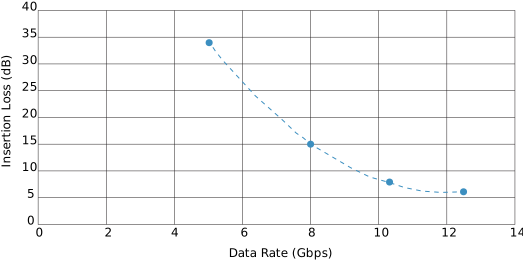
The maximum permitted channel insertion loss for RX operating in 32-bit or 64-bit data width modes is 25 dB across different data rates. For long-reach applications operating at higher bit rates, Efinix recommends using either 32-bit or 64-bit data width modes.
- M6: ~0.5 dB/inch
- FR4: ~1 dB/inch
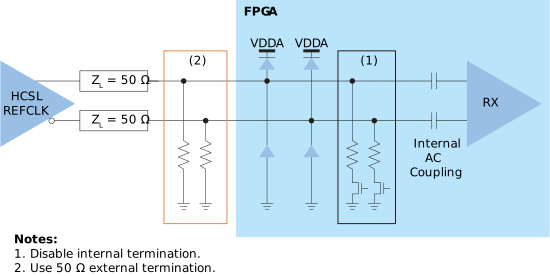
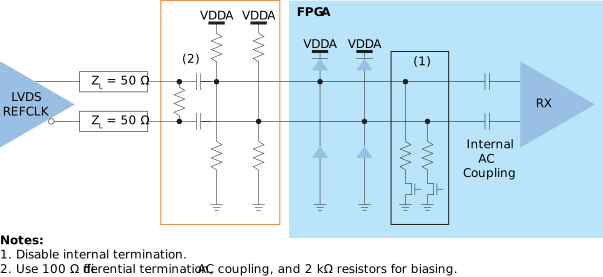
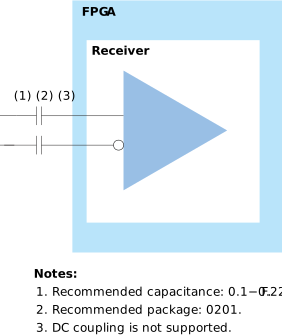
The PMA Direct PHY has the following AC coupling requirements. The PMA Direct REFCLK pin
supports HCSL or LVDS differential clock signals. Use an external biasing circuit to keep the
signal amplitude within the valid range. Consult the device data sheet for detailed REFCLK
specifications. Do not drive current into the HCSL REFCLK input pins before entering user
mode. If you cannot hold the external clock during
CRESET_N,
disable the internal termination and apply a 50 Ω external resistor.
10GBase-R/KR
Local Area Networks (LANs) conforming to the IEEE 802.3-2012 Ethernet Standard rely on optical modules, routers, and servers corresponding to the 10GBase-R standard. The electrical backplane, on the other hand, comprises a transmission medium corresponding to the 10GBase-KR standard.
The physical 10GBase-R/KR layer includes the Physical Medium Dependent (PMD), PMA, and PCS, which respectively comprise the physical connection, receive equalization/transmit equalization, receive clock recovery, parallel signal serialization/high-speed serial signal deserialization, and 64b/66b encoding and decoding. Because 10G uses 64b/66b encoding, the actual rate at which 10 Gbps data is transmitted over the medium after encoding is 10.3125 Gbps (i.e., 10 Gbps × 66 ÷ 64 = 10.3125 Gbps).
Therefore, the 10GBase-R/KR interface operates at a clock frequency of: 10312.5 ÷ 66 = 156.25 MHz.
10G SFP+ Interface
The 10G Enhanced Small Form-factor Pluggable (SFP+) optical module is a hot-swappable optical transceiver. It is commonly used in 10 Gbps applications, such as SONET/SDH, Fiber Channel, and 10 Gigabit Ethernet. For Titanium and Topaz boards, when configured as 10GBase-R in KR mode, the high-speed transceiver interface can work with an external 10G SFP+ optical module. An example connection can be found on the Titanium Ti375 N1156 Development Board.
Because the 10G SFP+ interface is widely used, the following section uses the 10G SFP+ interface as an example to introduce the 10G transceiver interface design.
The SFP+ interface is mainly divided into two parts: host and module. The host is part of the SFP+ optical module interface. The module itself does not consist of CDR circuits. Therefore, dimension and power consumption can be minimized.
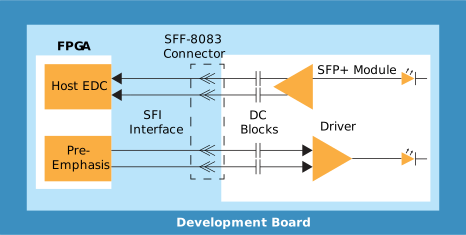
The electrical interface connecting the FPGA transceiver interface on the host side and the SFP+ optical module is referred to as a SerDes Framer Interface (SFI). This SFI electrical interface is based on high-speed, low-voltage AC coupling logic. The nominal differential impedance is 100 Ω, as shown in the following figure.
10G SFP+ Interface Pinout Description
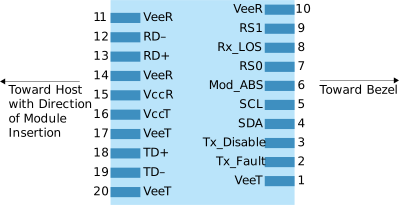
The following figure is a schematic diagram of the SFP+ interface signal on the host side, which corresponds to the 20-pin optical interface connector.
The following figure shows the pins on the side of the SFP+ optical module, which corresponds to the edge card connector of the optical module.
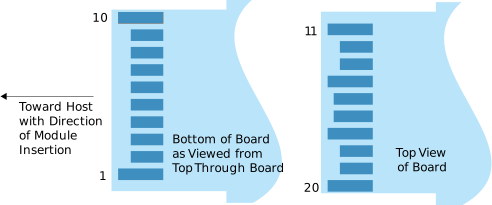
The following table describes the pin assignment of the SFP+ interface:
| Pin # | Signal Name | Logic Level | Description |
|---|---|---|---|
| 1 | VeeT | Module Transmitter Ground. | |
| 2 | TX_Fault | LVTTL-O | Module Transmitter Fault. Open-drain output, which needs to be pulled
up to VCC on the host side to indicate an error in the SFP+ module sending.
|
| 3 | TX_Disable | LVTTL-I | Transmitter Disable. Turns off transmitter laser output. Required connection to FPGA for transmission permission control. |
| 4 | SDA | LVTTL-I/O | Two-Wire Serial Interface Data Line. Pull-up resistor required.1 |
| 5 | SCL | LVTTL-I/O | Two-Wire Serial Interface Clock. Pull-up resistor required.1 |
| 6 | Mod_ABS | Module Absent, connected to VeeT or VeeR in the module. | |
| 7 | RS0 | LVTTL-I | Rate Select 0, optionally controls SFP+ module receiver. Connects to FPGA.2 |
| 8 | RX_LOS | LVTTL-O | Receiver Loss of Signal Indication (designated as RX_LOS
in FC and Signal Detect in Ethernet). Open-drain output, which
needs to be pulled up to VCC on the host side to instruct the SFP+ module to
receive LOS alarms. RX_LOS needs to be connected to the FPGA. If the system needs to select a clock source, the LOS
alarm will be monitored. |
| 9 | RS1 | LVTTL-I | Rate Select 1, optionally controls SFP+ module receiver. Connects to FPGA.2 |
| 10 | VeeR | Module Receiver Ground. | |
| 11 | VeeR | Module Receiver Ground. | |
| 12 | RD- | CML-O | Receiver Inverted Data Output. |
| 13 | RD+ | CML-O | Receiver Non-Inverted Data Output. |
| 14 | VeeR | Module Receiver Ground. | |
| 15 | VccR | Module Receiver 3.3 V Supply.3 | |
| 16 | VccT | Module Transmitter 3.3 V Supply.3 | |
| 17 | VeeT | Module Transmitter Ground. | |
| 18 | TD+ | CML-I | Transmitter Non-Inverted Data Input. |
| 19 | TD- | CML-I | Transmitter Inverted Data Input. |
| 20 | VeeT | Module Transmitter Ground. |
Differential Signals
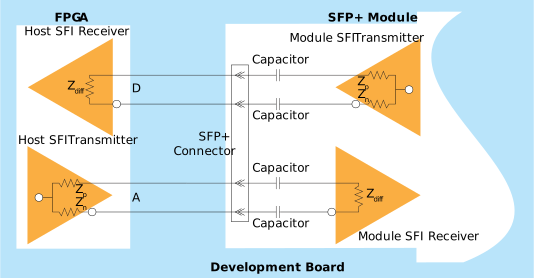
The signal pair is LVDS, which requires AC coupling. The SFP+ module has integrated AC coupling capacitors. The 100 Ω termination resistor can be configured inside the FPGA. Therefore, the transceiver's differential signal for the SFP+ interface is connected directly to the differential interface of the FPGA.
The following figure shows the transceiver interface connection of the SFP+ optical module.
Reference Clocks
Per Figure 5, there are only two pairs of differential signals between the SFP+ optical module and the FPGA’s transceiver interface. Nevertheless, the transceiver interface of the FPGA requires a reference clock for normal operation. For reference clock requirements and recommendations, see PMA Direct.
In 10GBase-R/KR mode, the reference clock frequency is 156.25 MHz. In SGMII mode, the reference clock frequency is 125 MHz.
The following table lists the typical electrical characteristics required of a 10G SFP+ interface reference clock.
| Requirements | Condition | Minimum | Typical | Maximum | Unit |
|---|---|---|---|---|---|
| Reference Clock Frequency | 156.25 | MHz | |||
| Frequency Stability | <25 | ppm | |||
| Jitter | <200 | fs | |||
| Rise Time | 20% ~ 80% | - | 200 | - | Ps |
| Drop Time | 80% ~ 20% | - | 200 | - | Ps |
| Duty Cycle Requirements | 40 | 50 | 60 | % | |
| Vpk-pk Voltage | 250 | - | 2,000 | mV | |
| Differential Input Impedance | - | 100 | - | Ω |
PCIe Interface
PCIe v4.0 offers greater flexibility and bandwidth over its v3.0 predecessor, with a maximum transfer rate of 16 GT/s. The following table outlines the line code and maximum transfer rate for each PCIe generation.
| Generation | Line code | Max. Transfer Rate (per lane) | |
|---|---|---|---|
| 1.0 | NRZ | 8b/10b | 2.5 GT/s |
| 2.0 | 5.0 GT/s | ||
| 3.0 | 128b/130b | 8.0 GT/s | |
| 4.0 | 16.0 GT/s | ||
Pin Definition
| Pin # | Side B | Side A | ||
|---|---|---|---|---|
| Name | Description | Name | Description | |
| 1 | +12 V | +12 V power | PRSNT1# | Hot-plug presence detected |
| 2 | +12 V | +12 V power | +12 V | +12 V power |
| 3 | +12 V | +12 V power | +12 V | +12 V power |
| 4 | GND | Ground | GND | Ground |
| 5 | SMNCLK | SMBus (System Management Bus) clock | JTAG2 | TCK Clock input for JTAG interface |
| 6 | SMBDAT | SMBus (System Management Bus) data | JTAG3 | TDI |
| 7 | GND | Ground | JTAG4 | TDO |
| 8 | +3.3 V | +3.3 V power | JTAG5 | TMS |
| 9 | JTAG1 | TRST# (Test Reset) Resets the JTAG interface. |
+3.3 V | +3.3 V power |
| 10 | +3.3 Vaux | +3.3 V auxillary power | +3.3 V | +3.3 V power |
| 11 | WAKE# | Signal for link reactivation | PERST# | Fundamental reset |
| Mechanical Key | ||||
| 12 | CLKREQ# | Clock Request Signal | GND | Ground |
| 13 | GND | Ground | REFCLK+ | Reference clock (differential pair) |
| 14 | PETp0 | Transmitter differential pair, lane 0 | REFCLK– | |
| 15 | PETn0 | Transmitter differential pair, lane 0 | GND | Ground |
| 16 | GND | Ground | PERp0 | Receiver differential pair, lane 0 |
| 17 | PRSNT2# | Hot-plug presence detected | PERn0 | |
| 18 | GND | Ground | GND | Ground |
| End of the x1 Connector | ||||
| 19 | PETp1 | Transmitter differential pair, lane 1 | RSVD | |
| 20 | PETn1 | GND | Ground | |
| 21 | GND | Ground | PERp1 | Receiver differential pair, lane 1 |
| 22 | GND | Ground | PERn1 | |
| 23 | PETp2 | Transmitter differential pair, lane 2 | GND | Ground |
PCIe Reference Clocks
The two main types of clock architecture in PCIe systems are common and separate reference clocks.
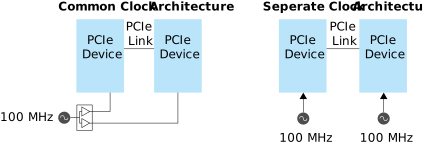
As the name suggests, in a common clock architecture the PCIe devices share the same PLL clock. This method is the most widely used clock architecture in PCIe systems. For PCIe Gen4 or below, the required frequency stability is ±300 ppm.
The separate clock architecture use different clock sources for the host and endpoint devices. The frequency stability requirement is ±100 ppm regardless of the system's bit rate. Both common and separate clock architectures support spread spectrum clocking (SSC) for reducing electromagnetic interference.
The jitter limit, shown in the following table, is specified according to PCIe generation.
| PCIe Generation | REFCLK Phase Jitter Limit (ps RMS) |
|---|---|
| PCIe 1.1 | 86 |
| PCIe 2.1 | 3.1 |
| PCIe 3.1 | 1.0 |
| PCIe 4.0 | 0.5 |
| Symbol | Parameter | 100 MHz Input | Units | |
|---|---|---|---|---|
| Min. | Max. | |||
| Rising Edge Rate | Rising Edge Rate 56 | 0.6 | 4.0 | V/ns |
| Falling Edge Rate | Falling Edge Rate56 | 0.6 | 4.0 | V/ns |
| VIH | Differential Input High Volatage5 | +150 | mV | |
| VIL | Differential Input Low Volatage5 | –150 | mV | |
| VCROSS | Absolute Crossing Point Voltage4 | +250 | +550 | mV |
| VCROSS DELTA | Variation of VCROSS Over All Rising Clock Edges4 | +140 | mV | |
| VRB | Ring-Back Voltage Margin5 | –100 | +100 | mV |
| TSTABLE | Time Before VRB is Allowed5 | 500 | ps | |
| TPERIOD AVG | Average Clock Period Accuracy5 | –300 | +2800 | ppm |
| TPERIOD ABS | Absolute Period (including Jitter and Spread Spectrum Modulation)5 | 9.847 | 10.203 | ns |
| TCCJITTER | Cycle to Cycle Jitter5 | 150 | ps | |
| VMAX | Absolute Maximum Input Voltage4 | +1.15 | V | |
| VMIN | Absolute Minimum Input Voltage4 | –0.3 | V | |
| Duty Cycle | Duty Cycle5 | 40 | 60 | % |
| Rise-Fall Matching | Rising Edge Rate (REFCLK+) to Falling Edge Rate (REFCLK–) Matching4 | 20 | % | |
| ZC-DC | Clock Source DC Impedance4 | 40 | 60 | Ω |
REFCLK0_P/N and
REFCLK1_P/N.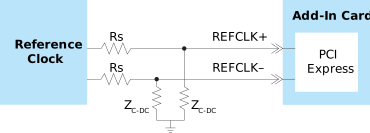
REFCLK0. The clock
multiplexer requires some clock toggling to switch from REFCLK0 to
REFCLK1. For more details, please refer to the
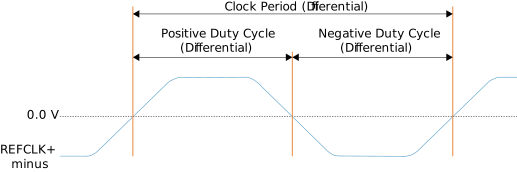
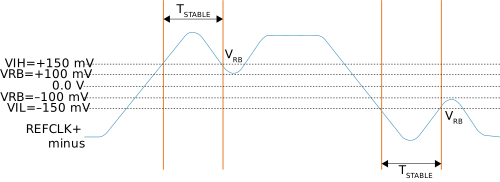
Titanium PCIe® Controller User Guide.For the reference clock measurement method, refer to the requirements in the following waveform diagrams:
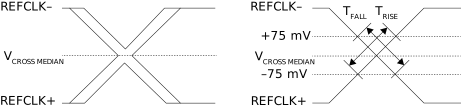
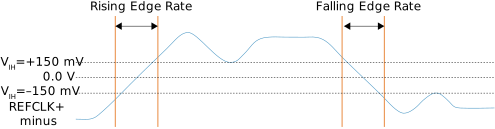
Reset Signals (PERST_N)
The reset signal is used by the host device to indicate that the device power and
reference clock are stable, and that link initialization is ready to begin. In Titanium and Topaz devices, the PERST pin must connect to a
dedicated pin, such as PERST_Q0_N or PERST_Q2_N, for proper
operation.
Implementing a Hot-Plug PCIe Interface
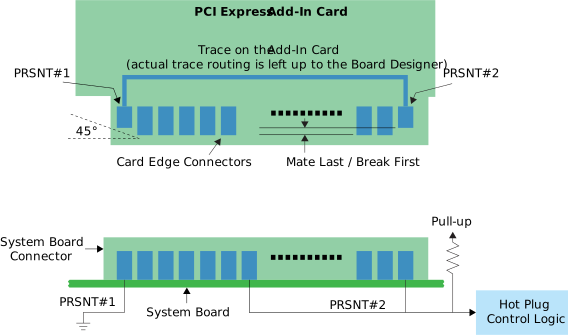
PRSNT1# and PRSNT2# pin connectors. These are the
first and the most distant pins on the add-in card. PRSNT1# and PRSNT2# are mapped on A1 and B31,
respectively.On the host board, if presence detection is supported, PRSNT1# must
connect to ground and PRSNT2# must connect with a pull-up resistor;
otherwise, both must be left unconnected. The following diagram illustrates hot-plug
implementation.
PCIe Interface Differential Signals
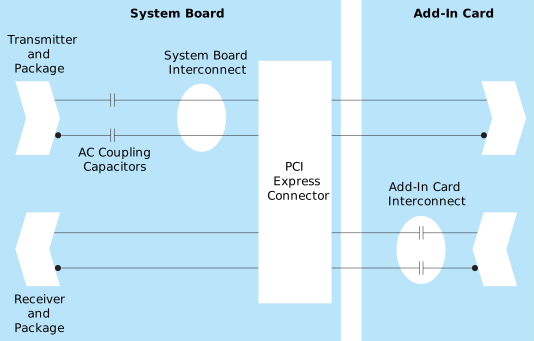
- PCIe interface differential signal uses AC coupling mode
- AC coupling capacitor is located on the TX side
- Capacitance size is 176 nF~265 nF
- Conventional selection is 220 nF
- Recommended package is 0201
Power Up Sequence
The PCIe endpoint device must follow the power-up sequence as described in the Titanium PCIe® Controller User Guide.
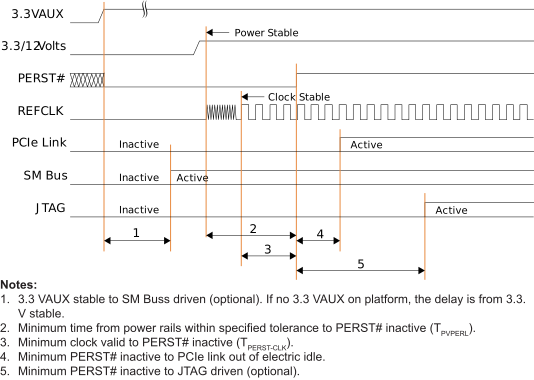
Boot-Up Timing Requirements
According to the PCIe specifications, the endpoint device must ensure that the board
completes boot-up within 100 ms after PERST# deasserted. Therefore, it is
necessary to take into consideration the following design concerns:
- Overall power-rail start-up timing.
- SPI, data width and data rate, configuration time.
- Using
PLL BL0orBR0for quad with an on-board oscillator as the PLL input clock source (depending on whether you are using quad 0 or quad1).
For more information, refer to the Titanium PCIe® Controller User Guide.
Power-Down Sequence
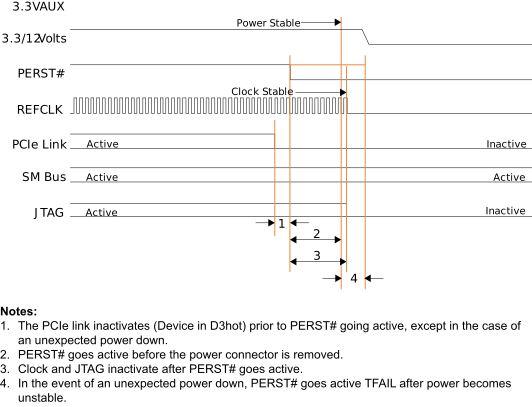
The correct power-down sequence for the PCIe interface is as follows:
- Before unplugging the AIC, the system must put the PCIe link into an inactive state.
- The host asserts
PERST#. - The system inactivates
REFCLKand JTAG.
The following waveform illustrates the power down process.
Pre-Emphasis, De-Emphasis, and Equalization
During signal transmission, different frequency components experience varying degrees of attenuation leading to distortion in the received signal. To achieve a better waveform at the receiving end, it is essential to compensate for signal degradation. Common compensation techniques include pre-emphasis, de-emphasis, and equalization.
In high-speed signal transmission, high-frequency components are attenuated significantly more than low-frequency components, thus causing the transmission line to behave like a low-pass filter.
Pre-Emphasis
Pre-emphasis involves boosting the signal's high-frequency components at the start of the transmission line to counteract the excessive attenuation they face during transmission. These high-frequency components are primarily found at the rising and falling edges of the signal. The pre-emphasis technique enhances the amplitude at these edges.
De-Emphasis
The goal is to maintain a constant amplitude at the rising and falling edges while reducing the amplitude of the signal elsewhere. This approach offers several advantages, such as lower power consumption and reduced electromagnetic interference (EMI).
Equalization
Equalization techniques can effectively address signal loss during transmission and improve overall signal quality. However, both pre-emphasis and de-emphasis techniques have their limitations; for example, they can inadvertently amplify high-frequency crosstalk, thereby exacerbating its impact. Equalization helps to mitigate these drawbacks. This technique functions as a high-pass filter, compensating for distorted pulses. An adaptive equalizer continuously adjusts its gain based on the actual digital signal transmitted, using an algorithm to respond to random channel changes. This adaptability ensures that the equalizer remains optimally configured, enhancing its ability to compensate for distortion.
PCB Design Considerations
- Board material selection
- PCB stack up
- Impredance control
- Routing guidelines
Board Material Selection
In high-frequency applications, the choice of board material is essential for ensuring optimal signal integrity, thermal management, and overall reliability. Materials with low dielectric constants and dissipation factors, high thermal stability, and good mechanical properties are essential for maintaining performance in high-speed electronic systems. Selecting the right material minimizes losses and enhances the efficiency of the circuit, thus making it a critical consideration in PCB design.
Dielectric Constant (Dk)
The dielectric constant (Dk), or relative permittivity, is a measure of a material's ability to store electrical energy in an electric field relative to the vacuum. Dk is a critical property in the design and performance of electronic circuits, particularly in high-frequency applications, such as RF and microwave circuits. A lower Dk value (less than 4) is preferred as it helps reduce signal loss and maintain signal integrity. Medium Dk materials (around 4 to 10) offer a balance between cost and performance.
Dissipation Factor (Df)
The dissipation factor (Df), also known as the loss tangent (δ), is a measure of how much energy from an electric field is lost as heat in a dielectric material. Df is a critical parameter in determining the efficiency and performance of electronic components, particularly in high-frequency applications. A low Df (less than 0.005) is essential for minimizing energy loss and heat generation, an is especially important in high-frequency scenarios. A medium Df (around 0.005 to 0.02) offers a balance between cost and performance.
Thermal Stability (Tg)
The Glass Transition Temperature (Tg) represents the temperature threshold at which resin transforms from a solid state to rubbery fluid. High-frequency circuits can generate significant heat. Materials with high Tg can better withstand thermal cycling and maintain their properties, ensuring reliable operation over time. Tg is one of the important characteristics of PCB substrates, and is classified as:
- General Tg sheet: 130℃-150℃, such as KB-6164F (140℃), S1141 (140℃)
- Medium Tg sheet: 150℃-170℃, such as KB-6165F (150℃), S1141 150 (150℃)
- High Tg sheet: 170℃ and above, such as KB-6167F (170℃), S1170 (170℃)
Other Considerations
Other PCB material properties, such as Conductive Anodic Filament (CAF), Thermal Conductivity (TC), Coefficient of Thermal Expansion (CTE), etc., must be considered in terms of the manufacturing of high-density, high-power applications.
| Type | Dk (1GHz) | Df (1GHz) | Price | Reference |
|---|---|---|---|---|
| Resin | 3.6 | 0.025 | Low | TU768/TU752/IT180A |
| PPE | 2.45 | 0.007 | High | Megtron6/TU883 |
| PTPE | 2.1 | 0.0004 | Very high | RO3000 Series |
PCB Stack Up
Due to the growth in the demand for more compact PCBs, the issue of design stack up has become increasingly important. Good PCB management also helps reduce EMI and improve signal integrity. Here are some rules for stack-up design:
- If the high-speed signal goes through the surface layer, the adjacent layer needs a complete ground plane.
- If the high-speed signal goes to the inner layer, the upper/lower adjacent layers should be placed with a complete ground plane.
- The power plane must be adjacent to the full ground plane layer and tightly coupled.
- TX and RX signals for high-speed differential signals should ideally be placed in different layers.
- From the perspective of EMC, a high-speed clock and high-speed parallel signal avoids surface wiring.
- Stackups need to be cost-effective.
According to the PCIe CEM specifications, the overall thickness of a PCIe card should be 1.57 mm.
Impedance Control
Target trace impedance for PCIe interfaces should follow the recommendations below. The tolerance for manufacturing should be kept at ±5%.
| PCIe Generation | Single-End Impedance (Units = Ω) |
Differential Impedance (Units = Ω) |
|---|---|---|
| Gen1 | 50 | 100 |
| Gen2 | 50 | 100 |
| Gen3 | 50 or 42.5 | 100 or 85 |
| Gen4 | 42.5 | 85 |
Routing Guidelines
In the course of designing your PCB, you must observe the following routing guidelines:
Microstrip vs Stripline
Microstrip traces are located on the surface layers while stripline is fully confined, meaning that it has minimal radiation and resistance to interference. There are no strict rules regarding which way the high-speed signals need to be routed. Engineering should make the determination between microstrip and stripline routine according the use case scenario. The following topics compare the advantages and disadvantages of microstrip vs stripline.
Microstrip
- Consists of a signal conductor strip and references to the adjacent ground plane with a layer of dielectric separation.
- Structure is simple, cost effective, and does not incur vias if interlayer routing is avoided. This strategy reduces the parasitic capacitance and inductance from via structure in high frequency applications. It also avoids signal reflection caused by via stubs.
- Reference plane is one-sided if the dielectric constant is less than the stripline, meaning that the transmission line delay is smaller and achievable for higher speed propagation.
- Microstrips are subject more interference as they are located on the surface layers.
Stripline
- Consists of an inner signal conductor strip sandwiched between two parallel reference planes (normally ground planes). These shield the signal and provide good EMC protection. However, fabrication complexity increases with the number of stack-up layers.
- Vias are required when traces change layers from top/bottom to inner. Through-hole vias introduce via stubs, which can be a source of signal reflection. Using blind or buried vias, or back drilling, can eliminate this issue, but increases production costs.
High-Speed Differential Trace Recommendations
The following recommendations are provided to ensure the quality of high-speed differential traces.
Trace Length
The trace length budget for add-in cards is a maximum of 101.6 mm, and with a maximum width of approximately 0.127 mm. Differential pairs are required to maintain equal width throughout the board.
Spacing
The spacing between P and N wires of the differential pairs is determined by the design impedance according to line width, copper thickness, PCB material, and lamination. The spacing should be kept constant throughout, from the main chip to the edge connector. For example, if the clock signal width is x1, the distance between the clock signal and other signals should be consistent at x5 spacing.
Skew Matching
The intra-pair skew requirement for high-speed differential pairs is <0.127 mm. There are no inter-pair skew requirements in the PCIe specification.
Bending
Round bending is recommended to maintain the continuity of impedance; however, 45° corners are acceptable. Do not use right-angle bends.
Other Routing Recommendations
Place TX and RX signals in different layers. Differential signal routing must be kept away from crystal oscillators, DC modules, magnetic components, and so on.
PCIe v4.0 Routing Guide
In addition to the common routing requirements for differential signals, it is also necessary to comply with the following PCIe v4.0 specifications:
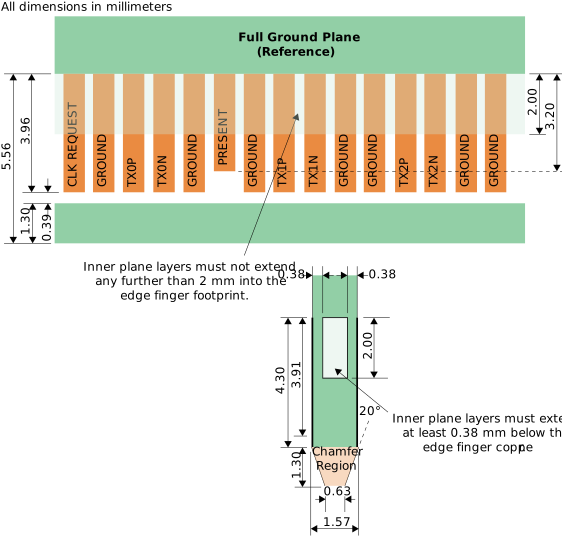
PCIe v4.0 Edge Card Connector Reference Plane
Per the PCIe v4.0 specifications, there is no inner conductor within 381 microns below the edge card connector, including no ground plane or power plane. It is recommended that the inner layer be more than 381 microns, and the ground plane placed to prevent crosstalk between TX and RX. Refer to the following diagram for details:
PCIe Edge Card Connector Length
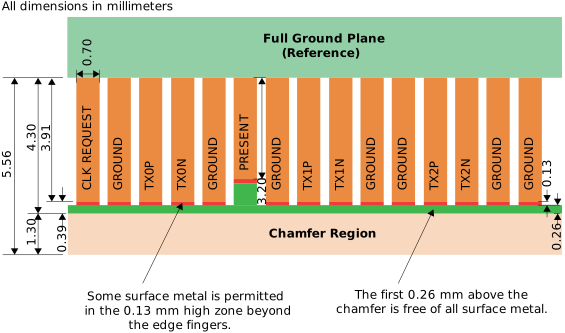
The length of the edge card connector is 3.91 mm, and the entire length (including the chamfer area) of the edge card connector is 5.6 mm. The space between the edge card connector area and the chamfer area is 0.39 mm, which is less than in Gen 1.
A small amount of residual surface metal is allowed within the 0.13 mm area beyond the lower end of the edge card connector.
The PRSNT1# or PRSNT2# pins should be 3.2 mm in
length, while the non-functional PRSNT2# edge card connector can be either
3.2 mm or 3.91 mm long.
Ground Hole Requirements
The ground hole of the edge card connector must be distributed in the middle of the adjacent pins of the edge card connector so as to reduce the interference of the signal outlet. From the top edge of the edge card connector to the bottom edge of the ground vias should not exceed 127 microns. The width of the traces connected to the ground via and ground pin must be greater than or equal to the diameter of the via pad to minimize ground inductance. The front and back ground pins of edge card connector can share ground vias.
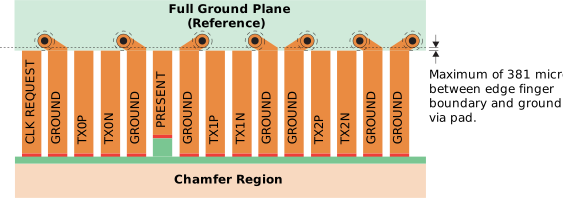
Merging Edge Card Connector Ground Vias
Edge card connector ground pins are adjacent to each other, with the ground vias connected to the ground pin connected together. The ground holes can also be shared on both sides.
Revision History
| Date | Version | Description |
|---|---|---|
| April 2026 | 1.3 | Add LVDS and HSCL RefClk recommended circuitry to PMA Direct.
(DOC-2931) Fix various typos. |
| February 2026 | 1.2 | Updated PMA Direct with AC coupling requirements. (DOC-2871) |
| July 2025 | 1.1 | Updated PMA Direct with RX insertion loss guidelines. (DOC-2619) |
| March 2025 | 1.0 | Initial Release. |