Microstrip and Stripline Skew
Two common methods to route high-speed lines are stripline, which sandwiches the signal line between ground planes, and microstrip, which lays the signal line on the board's surface. Efinix® recommends using stripline because it provides a better SNR for high-speed signals and helps to reduce skew.
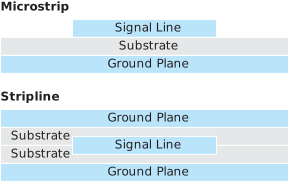
Skew is the timing delay difference between 2 or more signals. The following table shows
skew control recommendations for double data rate and single data rate domains for
various operating frequencies, as well as the recommended PCB skew for
CK to DQS timing.
To help the design process, the skew (in picoseconds) is converted to an approximate physical length (in inches) for both the microstrip and stripline routing methods.
| Speed (Bit Rate) | 400 Mhz, DDR 800 | 533 Mhz, DDR 1066 | |
|---|---|---|---|
| DQ to DQS | Skew in ps | 25 | 18 |
| Skew in inches of microstrip | 0.17 | 0.12 | |
| Skew in inches of stripline | 0.14 | 0.1 | |
| Address, control, and CA to CK | Skew in ps | 50 | 38 |
| Skew in inches of microstrip | 0.33 | 0.25 | |
| Skew in inches of stripline | 0.28 | 0.21 | |
| DQS to CK | Skew in ps | 188 | 141 |
| Skew in inches of microstrip | 1.25 | 0.93 | |
| Skew in inches of stripline | 1.04 | 0.78 | |