Clock and Reset
The APB Interconnect core has only 1 clock
source (clk) and 1 reset signal (rst_n), and operates
in a single clock domain. Efinix recommends the same
clock domain for both the APB Interconnect core
and the slave.
The reset signal, rst_n is an asynchronous reset. However, the
de-assertion of the reset signal is synchronous. An internal reset synchronizer is
available to synchronize the de-assertion of rst_n to
clk domain. The reset synchronizer has 1 to 2 clock cycles
latency.
The rst_n is an active low signal that needs to be initialized to
0 before the start of any operation.
Upon assertion of the reset signal, i.e., rst_n = 0,
the entire APB Interconnect core resets. In the
Round-Robin mode, the grant access resets to Master 0. In
Fixed-Priority mode, the grant access remains unchanged,
i.e., it is based on the masters' priority and the assertion of
s_apb_psel_i.
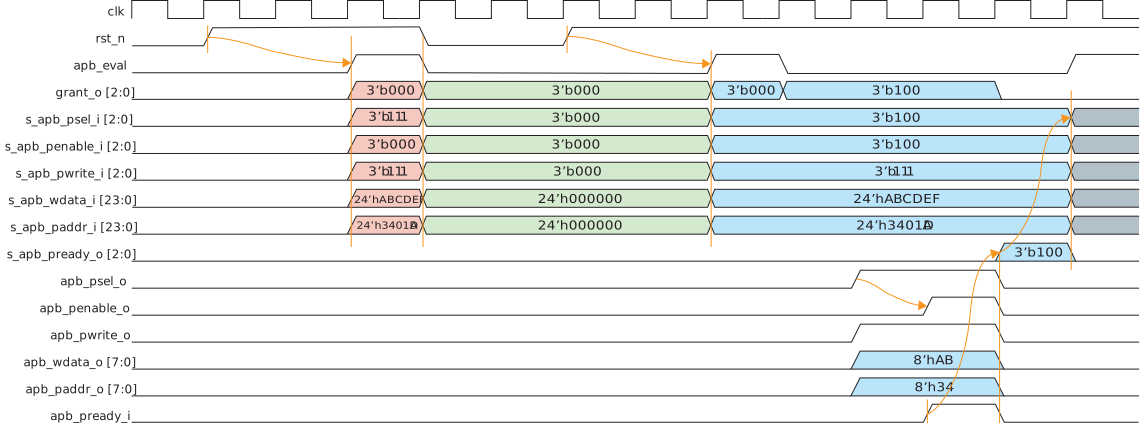
Upon de-assertion of the reset signal, i.e., rst_n = 1,
the APB Interconnect core becomes operational
after 1 to 2 clock cycles of reset synchronization. The apb_eval signal
becomes high, indicating that the APB
Interconnect core is in an EVALUATION state, where the
evaluation of all the masters' requests takes place to decide which master is to be
granted access.
apb_pready_i from the slave, which may not occur if the slave is in
a reset.The APB Interconnect core has a built-in latch
mechanism to cater for a situation where the granted master does not comply with the APB
protocol of maintaining the state of signals: s_apb_sel_i,
s_apb_penable_i, s_apb_pwrite_i,
s_apb_paddr_i, s_apb_pwdata_i,
s_apb_pwdata_par_i, s_apb_pstrb_i, and
s_apb_pstrb_par_i until the return of
s_apb_pready_o.
- Different reset domains between the granted master and the APB Interconnect core, where the granted master may encounter reset in the midst of an APB transfer.
- Signal corruption in the granted master during the APB transfer.
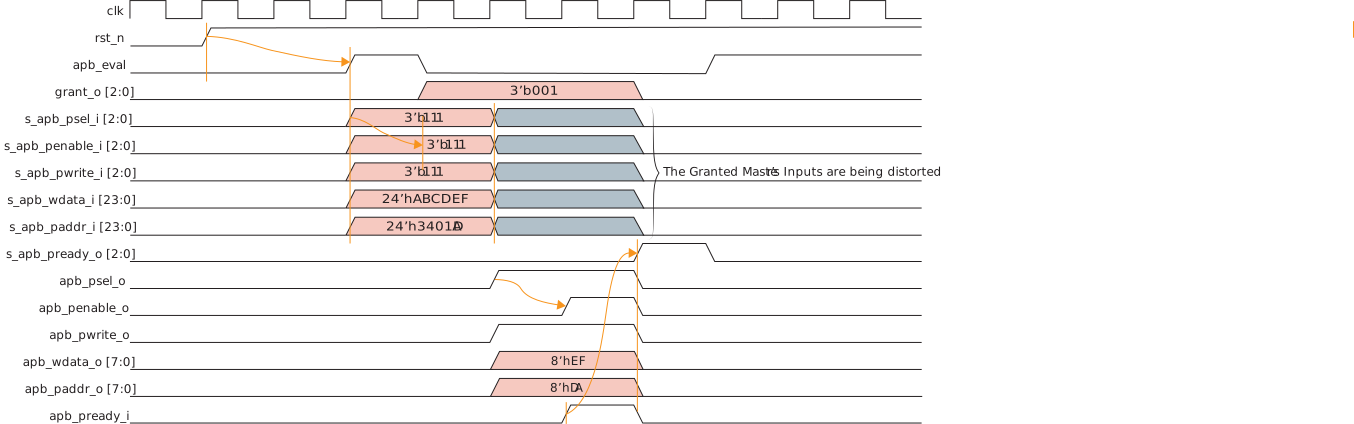
Figure 2 illustrates a
situation where the Master0 is requesting an APB write transfer, but an
independent reset event distorts Master_0's
s_apb_psel_i, s_apb_penable_i,
s_apb_pwrite_i, s_apb_paddr_i,
s_apb_pwdata_i before the return of
s_apb_pready_o. As indicated by grant_o, the APB Interconnect core has successfully granted
Master_0's request and propagates the granted request to the slave.
When the slave responses with the assertion of apb_pready_i, the
Master_0's s_apb_pready_o asserts too, marking the
completion of the write transfer, despite the distorted s_apb_sel_i in
the granted Master_0.
Using this same illustration, if the signal grant_o does not update to
3'b001, it indicates that the APB Interconnect
core is not successful in capturing the Master_0's request. Here, there
is no grant request for Master_0.