About the Example Design
This example targets Trion and Titanium development boards:
- Titanium Ti375 C529 Development Board—The RTL design files are in the Ti375C529_devkit directory.
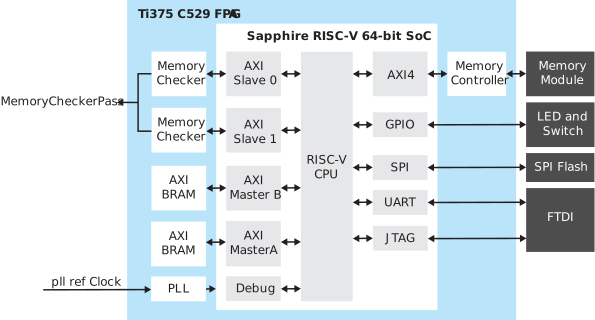
The example design automatically connects UART0, SPI0, I2C0, GPIO0, the JTAG pins, and the PLL source clock pins to top-level ports, and assigns I/O pins to these peripherals once enabled. If you add more of these peripherals, you need to manually connect and create I/O assignments.
The example design uses PLL settings to look for the best effort multiplier and divider values.
This example design uses a simple dual-port RAM module to write to and read from the development board's memory module using the AXI interface. For the Titanium Ti375 C529 Development Board, the design uses the board's LPDDR4/LPDDR4x DRAM module.
The example design software blinks an LED and displays messages on a UART terminal.
- 200 MHz system frequency, 50 MHz peripheral frequency
- All ISAs are enabled except Zicbom
- All microarchitecture features are enabled
- External memory interface is enabled with a width of 256 and a size of 1.0 GB
- L1 data cache and instruction cache set to one way with a cache size of 4 KB
- L2 cache set to 64 KB
- 4 KB on-chip RAM size
- UART 0 is enabled
- SPI 0 is enabled
- GPIO 0 is enabled
- APB3 0 is enabled
- AXI4 Slave 0 and 1 are enabled
- AXI Master A and B are enabled
| FPGA | Logic + Adders | Flipflops | Multipliers or DSP Blocks |
Memory Blocks | fMAX (MHz) | Language | Efinity Version |
|---|---|---|---|---|---|---|---|
| Ti375C529 | 42,457 | 35,061 | 17 | 296 | 204 | Verilog HDL | 2026.1 |