T20 SPI Flash Memory
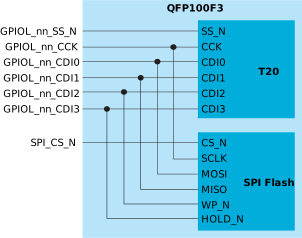
The QFP100F3 packages include a T20 FPGA and a SPI flash
memory. The SPI flash memory has a density of 16 Mbits and a clock rate of up
to 20 MHz. In active configuration mode, the FPGA is configured using the configuration
bitstream in the SPI flash memory. Typically you can fit
two
bitstream images into the QFP100F3 SPI flash. The SPI flash
memory's VCC is powered by VCCIO1A_1B_1C.
In SPI active configuration mode, the FPGA is configured using a bitstream stored in the SPI flash device. During configuration, the maximum clock frequency for the flash device is specified in T20 SPI Active. When the FPGA is in user mode, you can access the flash at the flash device's maximum clock frequency (although different SPI flash commands may have different maximum clock frequencies).
When a configuration bitstream is stored in the SPI flash and the SPI active hardware
connection is properly established, the SPI active configuration can automatically start
after the power-up. In QFP100F3 packages you are only required to connect the
SS_N pin to the SPI_CS_N pin for the SPI active
configuration to start automatically. This is additional to other required configuration
pin settings depending on the configuration mode you select.
You can also use the SPI flash to store user data during user mode. To read or write the SPI flash during user mode, you must create the SPI flash interface block in the Efinity Interface Designer.
| Signal | Direction | Description |
|---|---|---|
| SCLK | Input | Clock output to SPI flash memory. |
| MOSI | Input | Data output to SPI flash memory. |
| MISO | Output | Data input from SPI flash memory. |
| WP_N | Input | Active-low write protect signal. |
| HOLD_N | Input | Active-low hold signal. |
| SPI_CS_N | Input | Active-low SPI flash memory chip select. |