Tz100 DDR DRAM Interface
The DDR PHY interface supports LPDDR4 memories with x32 DQ widths and a memory controller hard IP block. The memory controller provides two full-duplex AXI4 buses to communicate with the FPGA core.
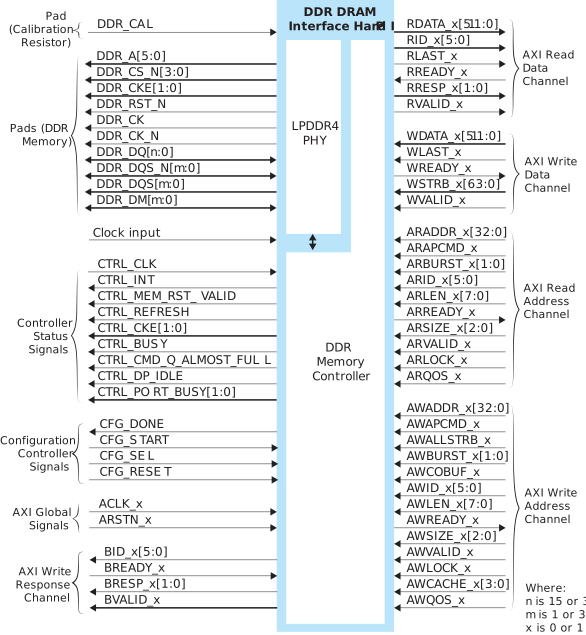
| Signal | Direction | Description |
|---|---|---|
| DDR_A[5:0] | Output | Address signals to the DRAM. |
| DDR_CS_N[3:0] | Output | Chip select to the DRAM. |
| DDR_CKE[1:0] | Output | Active-high clock enable signals to the DRAM. |
| DDR_RST_N | Output | Active-low reset signal to the DRAM. |
| DDR_CK | Output | Differential clock signals to the DRAM. |
| DDR_CK_N | Output | |
| DDR_DQ[n:0] | Bidirectional | Data bus to/from the memories. For writes, the FPGA drives these signals. For reads, the memory drives these signals. These signals are connected to the DQ pins on the memories. n is 15 or 31 depending on the Data Width setting. If unused, can be left floating on the board. |
| DDR_DQS_N[m:0] | Bidirectional | Differential data strobes to/from the memories. For writes, the FPGA drives these signals. For reads, the memory drives these signals. These signals are connected to the DQS pins on the memories. m is 1or 3 depending on the DQ width. If unused, can be left floating on the board. |
| DDR_DQS[m:0] | Bidirectional | |
| DDR_DM[m:0] | Bidirectional | Signals used as active-high data-mask and data bus inversion
indicator. m is 1 or 3 depending on the DQ width. If data bus
inversion is enabled for a write operation, the DDR controller will
drive the signal high if the write data byte is inverted. Similarly,
if data bus inversion is enabled for a read operation, the memory
device will drive the signal high if the read data byte is
inverted. If unused, can be left floating on the
board. |
| Signal | Direction | Description |
|---|---|---|
| DDR_CAL | Input | Calibration resistor connection. Connect to the ground through a 240 Ω resistor on your board. |
| Signal | Direction | Clock Domain | Description |
|---|---|---|---|
| CTRL_CLK | Input | N/A | Clock for controller status signals. |
| CTRL_INT | Output | N/A | Controller detects Interrupt. |
| CTRL_MEM_RST_VALID | Output | N/A | Controller has been reset. |
| CTRL_REFRESH | Output | CTRL_CLK | Indicate controller is executing refresh command. |
| CTRL_CKE[1:0] | Output | CTRL_CLK | Delayed 'control_cke' from the controller, indicating that the memory is in self-refresh or power down mode. |
| CTRL_BUSY | Output | CTRL_CLK | Controller is busy reading data. |
| CTRL_CMD_Q_ALMOST_FULL | Output | CTRL_CLK | Command queue reached 'q_fullness' parameter. |
| CTRL_DP_IDLE | Output | CTRL_CLK | Datapath is idle. |
| CTRL_PORT_BUSY[1:0] | Output | CTRL_CLK | Indicate if port is reading data. |
| Signal | Direction | Description |
|---|---|---|
| CFG_RESET | Input | Active-high configuration controller reset. Asserting this signal also resets the DDR controller, PHY and the DRAM device. |
| CFG_START | Input | Start the configuration controller. |
| CFG_DONE | Output | Indicates the configuration controller is done |
| CFG_SEL | Input | Tie this input to low to enable the configuration controller. |
| Signal | Direction | Clock Domain | Description |
|---|---|---|---|
| ACLK_x | Input | N/A | AXI4 clock inputs. |
| ARSTN_x | Input | ACLK_x | Active-low reset signal to the AXI interface. |
| Signal x is 0 or 1 |
Direction | Clock Domain | Description |
|---|---|---|---|
| BID_x[5:0] | Output | ACLK_x | Response ID tag. This signal is the ID tag of the write response. |
| BREADY_x | Input | ACLK_x | Response ready. This signal indicates that the master can accept a write response. |
| BRESP_x[1:0] | Output | ACLK_x | Read response. This signal indicates the status of the read transfer. |
| BVALID_x | Output | ACLK_x | Write response valid. This signal indicates that the channel is signaling a valid write response. |
| Signal x is 0 or 1 |
Direction | Clock Domain | Description |
|---|---|---|---|
| RDATA_x[511:0] | Output | ACLK_x | Read data. |
| RID_x[5:0] | Output | ACLK_x | Read ID tag. This signal is the identification tag for the read data group of signals generated by the slave. |
| RLAST_x | Output | ACLK_x | Read last. This signal indicates the last transfer in a read burst. |
| RREADY_x | Input | ACLK_x | Read ready. This signal indicates that the master can accept the read data and response information. |
| RRESP_x[1:0] | Output | ACLK_x | Read response. This signal indicates the status of the read transfer. |
| RVALID_x | Output | ACLK_x | Read valid. This signal indicates that the channel is signaling the required read data. |
| Signal x is 0 or 1 |
Direction | Clock Domain | Description |
|---|---|---|---|
| WDATA_x[511:0] | Input | ACLK_x | Write data. |
| WLAST_x | Input | ACLK_x | Write last. This signal indicates the last transfer in a write burst. |
| WREADY_x | Output | ACLK_x | Write ready. This signal indicates that the slave can accept the write data. |
| WSTRB_x[63:0] | Input | ACLK_x | Write strobes. This signal indicates which byte lanes hold valid data. There is one write strobe bit for each eight bits of the write data bus. |
| WVALID_x | Input | ACLK_x | Write valid. This signal indicates that valid write data and strobes are available. |
| Signal x is 0 or 1 |
Direction | Clock Domain | Description |
|---|---|---|---|
| ARADDR_x[32:0] | Input | ACLK_x | Read address. It gives the address of the first transfer in a burst transaction. |
| ARBURST_x[1:0] | Input | ACLK_x | Burst type. The burst type and the size determine
how the address for each transfer within the burst is
calculated. ’b01 = INCR ’b10 = WRAP |
| ARID_x[5:0] | Input | ACLK_x | Address ID. This signal identifies the group of address signals. |
| ARLEN_x[7:0] | Input | ACLK_x | Burst length. This signal indicates the number of transfers in a burst. |
| ARREADY_x | Output | ACLK_x | Address ready. This signal indicates that the slave is ready to accept an address and associated control signals. |
| ARSIZE_x[2:0] | Input | ACLK_x | Burst size. This signal indicates the size of each transfer in the burst. |
| ARVALID_x | Input | ACLK_x | Address valid. This signal indicates that the channel is signaling valid address and control information. |
| ARLOCK_x | Input | ACLK_x | Lock type. This signal provides additional information about the atomic characteristics of the transfer. |
| ARAPCMD_x | Input | ACLK_x | Read auto-precharge. |
| ARQOS_x | Input | ACLK_x | QoS identifier for read transaction. |
| Signal x is 0 or 1 |
Direction | Clock Domain | Description |
|---|---|---|---|
| AWADDR_x[32:0] | Input | ACLK_x | Write address. It gives the address of the first transfer in a burst transaction. |
| AWBURST_x[1:0] | Input | ACLK_x | Burst type. The burst type and the size determine how the address for each transfer within the burst is calculated. |
| AWID_x[5:0] | Input | ACLK_x | Address ID. This signal identifies the group of address signals. |
| AWLEN_x[7:0] | Input | ACLK_x | Burst length. This signal indicates the number of transfers in a burst. |
| AWREADY_x | Output | ACLK_x | Address ready. This signal indicates that the slave is ready to accept an address and associated control signals. |
| AWSIZE_x[2:0] | Input | ACLK_x | Burst size. This signal indicates the size of each transfer in the burst. |
| AWVALID_x | Input | ACLK_x | Address valid. This signal indicates that the channel is signaling valid address and control information. |
| AWLOCK_x | Input | ACLK_x | Lock type. This signal provides additional information about the atomic characteristics of the transfer. |
| AWAPCMD_x | Input | ACLK_x | Write auto-precharge. |
| AWQOS_x | Input | ACLK_x | QoS identifier for write transaction. |
| AWCACHE_x[3:0] | Input | ACLK_x | Memory type. This signal indicates how transactions are required to progress through a system. |
| AWALLSTRB_x | Input | ACLK_x | Write all strobes asserted. The DDR controller only supports a maximum of 16 AXI beats for write commands using this signal. |
| AWCOBUF_x | Input | ACLK_x | Write coherent bufferable
selection. AWCACHE_x must be set to 'b1111
for AWCOBUF_x when:
When AWCACHE_x is set to 'b0000:
|
DDR DRAM Interface Input Clocks
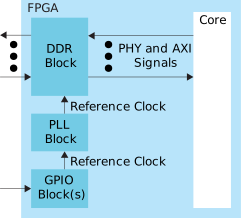
You only need one clock to drive the DDR DRAM interface block. To select the PLL as the clock source for the DDR DRAM block, choose CLKIN 0, CLKIN 1, or CLKIN 2 as the Clock Source in the Interface Designer.
| DDR Block | PLL Resource | PLL CLKOUT | ||
|---|---|---|---|---|
| CLKIN 0 | CLKIN 1 | CLKIN 2 | ||
| DDR 0 | BL0 | BL1 | BL2 | CLKOUT3 |
CLKOUT3 of the selected PLL drives the DDR DRAM interface block. The
clock runs at a quarter of the PHY data rate (for example, 2,000 Mbps
requires a 500 MHz clock). You need to instantiate the selected PLL in the Interface
Designer and configure the PLL's CLKOUT3 with the required
frequency. The Efinity software then connects the PLL's
CLKOUT3 signal to the DDR DRAM interface block
automatically.