1. What were the key themes or observations you took away from ITE Yokohama this year?
ITE Yokohama continues to reinforce Japan’s leadership in machine vision and imaging systems. The strongest themes this year were multi-sensor fusion, higher-bandwidth imaging pipelines, and the growing role of edge AI acceleration. We also saw clear momentum toward power-efficient, compact embedded systems where thermal, integration, and reliability constraints drive architecture choices.
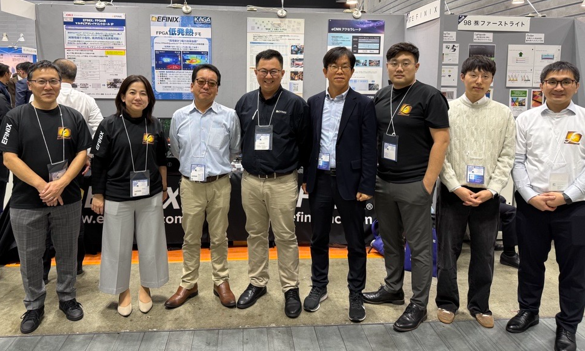
While ITE primarily features camera manufacturers and machine vision vendors, the level of attention on AI-driven solutions, particularly Efinix’s edge AI demonstrations, was notably high and reflected a broader shift toward AI-integrated vision systems.
2. How were Efinix devices used across the exhibits at ITE Yokohama?
Titanium devices appeared in multiple booths across the show floor, powering real customer systems. Examples include:
Infineon FX10 USB camera pipeline using Ti180 for long-reach USB video.
Infineon FX20 Quad-sensor synchronized camera with data aggregation on Ti180.
CIS SLVS-EC high-speed sensor interface implemented on the Ti375 PCIe card.
NetVision GMSL-to-USB embedded vision pipeline, built around Ti180 for real-time deserialization and streaming.
MIPI A-PHY Showcase – Joint demonstration with Valens, CIS, iMavix, MVtec, and Efinix Ti375, featured inside the International Machine Vision Standardization booth.
At the Efinix booth, we showcased:
Ti375 PCIe card running high-bandwidth transceiver demos and performance comparisons.
Ti180 SIP MIPI camera streaming platform, highlighting ultra-low power and small-form-factor edge vision.
eCNN Edge-AI demo, demonstrating efficient neural-network acceleration on Titanium devices.
Ti60-based ultra-compact medical and industrial imaging solutions, emphasizing low-power FPGA integration.
Across all these exhibits, it was clear that customers value Titanium for its low-power efficiency, transceiver and MIPI flexibility, compact form factor, and strong performance for real-time imaging and sensor interfaces.
3. What technology developments or trends stood out as important?
Three trends stood out clearly:
Higher-speed sensor interfaces such as SLVS-EC and advanced MIPI pipelines Ti180 SIP MIPI camera streaming platform, highlighting ultra-low power and small-form-factor edge vision.
Edge AI inference for preprocessing, AI ISP, and real-time analytics at the device level.
Evolving interconnect standards — USB, MIPI A-PHY, GMSL, and multi-camera topologies becoming standard in industrial, robotics, and automotive systems.
All three areas align closely with Titanium’s direction and our expanding transceiver and MIPI ecosystem.
4. What types of feedback or insights did you hear from customers and partners?
Feedback throughout the event was consistently strong. Customers emphasized:
Clear confidence in Titanium’s power efficiency, thermal behavior, and reliability in deployed systems.
Recognition that our transceiver, MIPI, and high-speed connectivity capabilities are now proven and production-ready.
Positive validation of our expanding ecosystem — from camera interfaces and high-speed protocols to vision pipelines and RISC-V SoC solutions.
Across conversations, it was evident that Efinix is now viewed as a credible, established, and technically differentiated FPGA platform for industrial vision and embedded systems — a serious option for new designs and long-term roadmaps.
5. How did ITE align with Efinix’s product direction and roadmap?
The event strongly validated our focus areas:
Vision interfaces (MIPI, SLVS-EC, GMSL).
High-speed transceiver across PCIe, Ethernet, SDI.
RISC-V compute + AI acceleration for edge processing.
Smaller, lower-power form factors for embedded applications.
The market trajectory we observed aligns precisely with our Titanium expansion and the broader Edge AI strategy. We also observed Titanium Ti375N1156C-DK platforms being used in other booths to implement next-generation standards such as 10GigE Vision and MIPI A-PHY.
6. How are developers leveraging Titanium across different applications?
Developers see Titanium as a platform, not just an FPGA. Common use cases include:
Industrial cameras — sensor interface + pre and post processing.
Automotive and robotics — multi-camera fusion, low-latency pipelines.
AI-assisted vision — super-resolution, detection, segmentation.
Connectivity bridges — PCIe ↔ Ethernet, MIPI APHY ↔ GigeVision, MIPI ↔ USB, GMSL ↔ UVC.
The feedback is that Titanium gives them performance they can deploy, even in thermally constrained systems.
7. After this year’s event, what opportunities are you most looking forward to?
We see strong opportunities in:
Next-generation industrial cameras.
Expanded partnerships across the vision and transceiver ecosystem.
RISC-V–based embedded platforms.
Edge AI acceleration as part of complete vision pipelines.
Japan customers are prioritizing compact, efficient, deterministic systems — which aligns well with our strengths.
8. Anything else you’d like to share about your experience?
ITE Yokohama clearly showed that Efinix now has visible brand presence, strong customer adoption, and increasing trust across the machine-vision ecosystem. The traction we are seeing reflects the maturity of the Titanium platform and growing confidence in our roadmap.
Final Thoughts
ITE Yokohama 2025 was a solid opportunity to engage with customers and partners and see real vision systems in action. The event reinforced Titanium’s presence in deployed machine vision designs.
Interested in learning more about the technologies discussed at ITE Yokohama 2025?
Connect with the Efinix team.