Ti375 HSIO Configured as GPIO
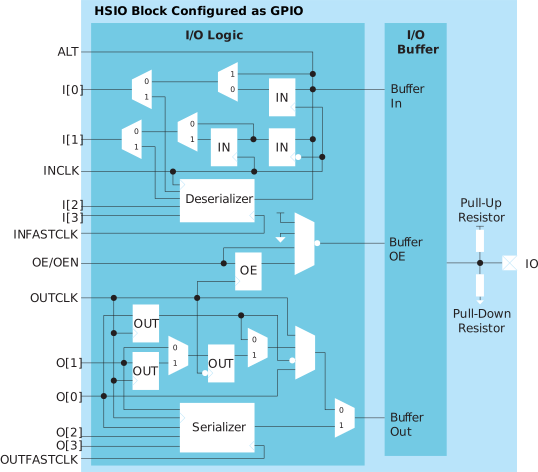
You can configure each HSIO block as two GPIO (single-ended) or one GPIO (differential).
| Signal | Direction | Description |
|---|---|---|
| I[3:0] | Output | Input data from the pad to the core fabric. I[0] is the normal
input to the core. In DDIO mode, I[0] is the data captured on the
positive clock edge (HI pin name in the Interface Designer) and I[1]
is the data captured on the negative clock edge (LO pin name in the
Interface Designer). When using the deserializer, the
first bit is on I[0] and the last bit is on I[3]. |
| ALT | Output | Alternative input connection for GCLK, PLL_CLKIN, RCLK, PLL_EXTFB,
and VREF. (In the Interface Designer, Register
Option is none).
|
| O[3:0] | Input | Output data to GPIO pad from the core fabric. O[0] is the normal
output from the core. In DDIO mode, O[0] is the data output on the
positive clock edge (HI pin name in the Interface Designer) and O[1]
is the data output on the negative clock edge (LO pin name in the
Interface Designer). When using the serializer, the first
bit is on O[0] and the last bit is on O[3]. |
| OE/OEN | Input | Output enable from core fabric to the I/O block. Can be
registered. OEN is used in differential mode. Drive it with the
same signal as OE. |
| DLYCLK | Input | Delay clock for dynamic delay, sampled on the negative edge. In serializer mode, this clock must be the same clock as INCLK. |
| DLY_ENA | Input | (Optional) Enable the dynamic delay control. Assert or de-assert the signal on the falling edge of DLYCLK in your RTL design. |
| DLY_INC | Input | (Optional) Dynamic delay control. When DLY_ENA =
1, 1: Increments 0: Decrements Assert or
de-assert this signal on the falling edge of DLYCLK in your RTL
design. The updated delay count takes effect approximately 5 ns
after the rising edge of DLYCLK in the HSIO
block. |
| DLY_RST | Input | (Optional) Reset the delay counter. |
| OUTCLK | Input | Core clock that controls the output and OE registers. This clock is not visible in the user netlist. |
| OUTFASTCLK | Input | Core clock that controls the output serializer. |
| INCLK | Input | Core clock that controls the input registers. This clock is not visible in the user netlist. |
| INFASTCLK | Input | Core clock that controls the input serializer. |
| Signal | Direction | Description |
|---|---|---|
| IO (P and N) | Bidirectional | GPIO pad. |
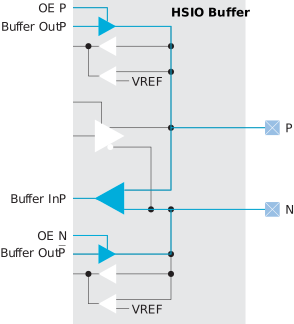
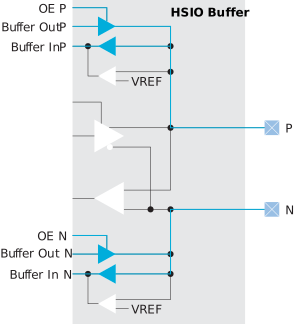
The signal path from the pad through the I/O buffer changes depending on the I/O standard you are using. The following figures show the paths for the supported standards. The blue highlight indicates the path.
When using an HSIO with the HSTL or SSTL I/O standards, you must configure
an I/O pad of the standard's input path as a VREF pin. There is one
programmable VREF per I/O bank.
VREF pin, you must use the VREF from the same
physical I/O bank even when the I/O banks are merged to share a common VCCIO pin.VREF pin bonded out, the banks' GPIO pins do not support the
HSTL and SSTL input I/O standards.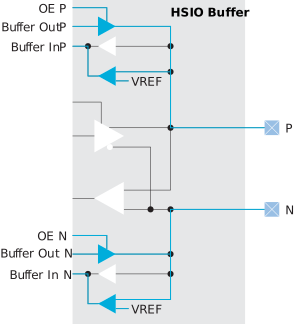
When using an HSIO with the differential HSTL or differential SSTL standard, you must use both GPIO resources in the HSIO. You use the core interface pins associated with the P resource.